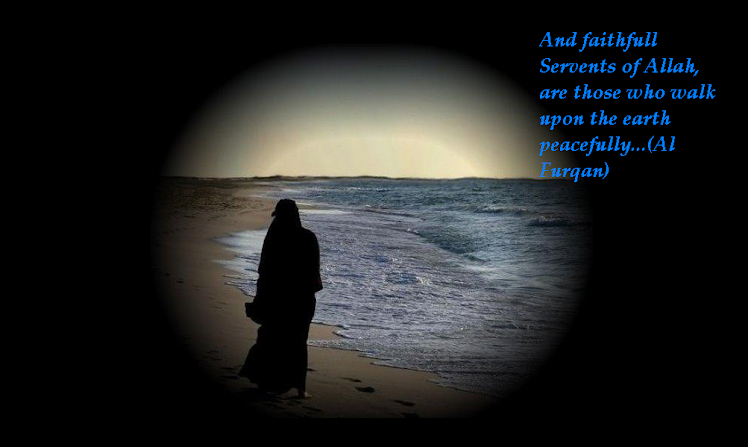
Thursday, August 4, 2011

Tuesday, July 27, 2010
My steps toward Allah....
My steps toward Allah

Forgive me Ya Rabby...I made my heart away from You for the moment,. Forgive me Ya Rabby, Your Servent is sinfull, fullfill my heart with honest Love towerd You, and everything that leads to You, as I feel my soul with repetance to You, my eyes with tears,and my heart with shame of You. Forgive me my Lord, do not get angry on me, You are The Most Mercyfull, do not let that I ever forget You even on one moment, that I fear only of You, and that I look only that You be pleased with me.
Make my steps firm and strong on Your way... Make my worry only one, make my wish only one.... that You be pleased with me... Oh Allah, You are The Most Mercyfull, please be mercyfull towerd Your Servent, keep my heart close to You always.
Oh Allah, make my steps firm towerd You.....
Monday, July 5, 2010
Ya Ukhty!!!

My sister....
Do not be sad!!! Do not cry!!! Do not worry!!! I know that maybe now my words do not mean nothing to you, and I say be patiente, forget about it.Now when I look at you, I see, I see much deep... No, I do not see but I feel. Sadness is coming from your eyes, and I wonder what has happend to my sister, when did she lost her hope. I wonder which hardships have made my sister to feel like this, and which tests from Allah....
You say, it is nothing, and that it will pass soon... You eman and pride to be Servent of Allah, does not let you to say what is making you so much worry, that is not letting you to say the words of sadness trough your sweet voice always. No, you feel afraid to say even one word, which will fly like flight of butterflys, because in your world it means to disobey to Allah, The Creator of all Worlds.
SubhanAllah.... How many times you have helped me, when I felt sad and dissaopinted. I feel myselfe obligated to take your hand, so that we can go together in gardens of Allah, where we will rest our eyes. Come with me sister, leave all that worris which are making your heart so hard. You are stenght, you are strong!!!Allah is with you, you have something what others do not have, you have treasure in your heart. Do not give it and sell it to Shaytan.. No,never!!!!
And you just listen me, and make dhikr of your fingers of silk. Because dhikr is the most beautiful speach. But understand, my sweet sister, that what is in soul is reflecting in ones face and behaviour, and deeds. I know that you try to be Servent of Allah, but do not make such burden on yourselfe, because Allah do not put burden on anyone over his possibilties.
And you are just looking at me, I know I have red you now. It has happen to me many times, and after I would get back full of happiness, new hope and wish for life.
I am leaving sister now, and leaving you in mercy of Allah. That Allah make us both His good and honest Servents,and make our hearts firm in His religion. ameen summa ameen
Friday, June 25, 2010
Allahs Servent, Insha Allah
.... I am the prisioner of my own being, my own reason, and my own feelings....
... And praise be to You my Allah, because I can not escape., and life is not mine, every belongs to You.... Subhan Allah
... And praise be to You my Allah, because I can not escape., and life is not mine, every belongs to You.... Subhan Allah
Tuesday, June 22, 2010
In The name of Allah, The Most Mercyfull, The Most Compassionate
All Praise be due to Allah subhan we teala His blessings and lofty, gracious and kind favours... And indead the most greatest of these blessings without any exception, is Allahs Clear Book ( Quran) and straight path ( Sirratelmusteqim), by which Allah leads His Servents from darkness to light. All praise be to Allah for making us Muslims how He called us long time ago, and for filing our hearts with light and expending our chests( freeing them from tightness of disbelif and ignorance).
All Praise be to Allah for remanding us on Day of Judgment and meeting with Him that promissed, on which niether parent, neither child will be of any avail. All praise be to Allah for showing us straight path with His Clear Book ( Quran) and with His Last Messanger Mohammed sallahu alayha wa salam and his clear Sunnah, to be our gudiance towerd neerness of Allah.
All Praise be due to Allah subhan we teala His blessings and lofty, gracious and kind favours... And indead the most greatest of these blessings without any exception, is Allahs Clear Book ( Quran) and straight path ( Sirratelmusteqim), by which Allah leads His Servents from darkness to light. All praise be to Allah for making us Muslims how He called us long time ago, and for filing our hearts with light and expending our chests( freeing them from tightness of disbelif and ignorance).
All Praise be to Allah for remanding us on Day of Judgment and meeting with Him that promissed, on which niether parent, neither child will be of any avail. All praise be to Allah for showing us straight path with His Clear Book ( Quran) and with His Last Messanger Mohammed sallahu alayha wa salam and his clear Sunnah, to be our gudiance towerd neerness of Allah.
Wednesday, June 9, 2010
The Status of Women in Islaam~~~
The Status of Women in Islaam
. INTRODUCTION
The status of women in society is neither a new issue nor is it a fully settled one.
The position of Islam on this issue has been among the subjects presented to the Western reader with the least objectivity.
This paper is intended to provide a brief and authentic exposition of what Islam stands for in this regard. The teachings of Islam are based essentially on the Quran (God's revelation) and Hadeeth (elaboration by Prophet Muhammad).
The Quran and the Hadeeth, properly and unbiasedly understood, provide the basic source of authentication for any position or view which is attributed to Islam.
The paper starts with a brief survey of the status of women in the pre-Islamic era. It then focuses on these major questions: What is the position of Islam regarding the status of woman in society? How similar or different is that position from "the spirit of the time," which was dominant when Islam was revealed? How would this compare with the "rights" which were finally gained by woman in recent decades?
II. HISTORICAL PERSPECTIVES
One major objective of this paper is to provide a fair evaluation of what Islam contributed (or failed to contribute) toward the restoration of woman's dignity and rights. In order to achieve this objective, it may be useful to review briefly how women were treated in general in previous civilizations and religions, especially those which preceded Islam (Pre-610 C.E.). Part of the information provided here, however, describes the status of woman as late as the nineteenth century, more than twelve centuries after Islam.
Women in Ancient Civilization
Describing the status of the Indian woman, Encyclopedia Britannica states:
In India, subjection was a cardinal principle. Day and night must women be held by their protectors in a state of dependence says Manu. The rule of inheritance was agnatic, that is descent traced through males to the exclusion of females.
In Hindu scriptures, the description of a good wife is as follows: "a woman whose mind, speech and body are kept in subjection, acquires high renown in this world, and, in the next, the same abode with her husband."
In Athens, women were not better off than either the Indian or the Roman women.
"Athenian women were always minors, subject to some male - to their father, to their brother, or to some of their male kin.
Her consent in marriage was not generally thought to be necessary and "she was obliged to submit to the wishes of her parents, and receive from them her husband and her lord, even though he were stranger to her."
A Roman wife was described by an historian as: "a babe, a minor, a ward, a person incapable of doing or acting anything according to her own individual taste, a person continually under the tutelage and guardianship of her husband."
In the Encyclopedia Britannica, we find a summary of the legal status of women in the Roman civilization:
In Roman Law a woman was even in historic times completely dependent. If married she and her property passed into the power of her husband . . . the wife was the purchased property of her husband, and like a slave acquired only for his benefit. A woman could not exercise any civil or public office . could not be a witness, surety, tutor, or curator; she could not adopt or be adopted, or make will or contract. Among the Scandinavian races women were:
under perpetual tutelage, whether married or unmarried. As late as the Code of Christian V, at the end of the 17th Century, it was enacted that if a woman married without the consent of her tutor he might have, if he wished, administration and usufruct of her goods during her life.
According to the English Common Law:
...all real property which a wife held at the time of a marriage became a possession of her husband. He was entitled to the rent from the land and to any profit which might be made from operating the estate during the joint life of the spouses. As time passed, the English courts devised means to forbid a husband's transferring real property without the consent of his wife, but he still retained the right to manage it and to receive the money which it produced. As to a wife's personal property, the husband's power was complete. He had the right to spend it as he saw fit.
Only by the late nineteenth Century did the situation start to improve. "By a series of acts starting with the Married women's Property Act in 1870, amended in 1882 and 1887, married women achieved the right to own property and to enter contracts on a par with spinsters, widows, and divorcees." As late as the Nineteenth Century an authority in ancient law, Sir Henry Maine, wrote: "No society which preserves any tincture of Christian institutions is likely to restore to married women the personal liberty conferred on them by the Middle Roman Law."
III. WOMAN IN ISLAM
In the midst of the darkness that engulfed the world, the divine revelation echoed in the wide desert of Arabia with a fresh, noble, and universal message to humanity: "O Mankind, keep your duty to your Lord who created you from a single soul and from it created its mate (of same kind) and from them twain has spread a multitude of men and women" (Quran 4: 1).
A scholar who pondered about this verse states: "It is believed that there is no text, old or new, that deals with the humanity of the woman from all aspects with such amazing brevity, eloquence, depth, and originality as this divine decree."
Stressing this noble and natural conception, the Quran states:
He (God) it is who did create you from a single soul and therefrom did create his mate, that he might dwell with her (in love)….(Quran 7:189)
The Creator of heavens and earth: He has made for you pairs from among yourselves ...Quran 42:1 1
And Allah has given you mates of your own nature, and has given you from your mates, children and grandchildren, and has made provision of good things for you. Is it then in vanity that they believe and in the grace of God that they disbelieve? Quran 16:72
The rest of this paper outlines the position of Islam regarding the status of woman in society from its various aspects - spiritually, socially, economically and politically.
1. The Spiritual Aspect
The Quran provides clear-cut evidence that woman in completely equated with man in the sight of God in terms of her rights and responsibilities. The Quran states:
"Every soul will be (held) in pledge for its deeds" (Quran 74:38). It also states:
...So their Lord accepted their prayers, (saying): I will not suffer to be lost the work of any of you whether male or female. You proceed one from another ...(Quran 3: 195).
Whoever works righteousness, man or woman, and has faith, verily to him will We give a new life that is good and pure, and We will bestow on such their reward according to the their actions. (Quran 16:97, see also 4:124).
Woman according to the Quran is not blamed for Adam's first mistake. Both were jointly wrong in their disobedience to God, both repented, and both were forgiven. (Quran 2:36, 7:20 - 24). In one verse in fact (20:121), Adam specifically, was blamed.
In terms of religious obligations, such as the Daily Prayers, Fasting, Poor-due, and Pilgrimage, woman is no different from man. In some cases indeed, woman has certain advantages over man. For example, the woman is exempted from the daily prayers and from fasting during her menstrual periods and forty days after childbirth. She is also exempted from fasting during her pregnancy and when she is nursing her baby if there is any threat to her health or her baby's. If the missed fasting is obligatory (during the month of Ramadan), she can make up for the missed days whenever she can. She does not have to make up for the prayers missed for any of the above reasons. Although women can and did go into the mosque during the days of the prophet and thereafter attendance et the Friday congregational prayers is optional for them while it is mandatory for men (on Friday).
This is clearly a tender touch of the Islamic teachings for they are considerate of the fact that a woman may be nursing her baby or caring for him, and thus may be unable to go out to the mosque at the time of the prayers. They also take into account the physiological and psychological changes associated with her natural female functions.
2. The Social Aspect
a) As a child and an adolescent
Despite the social acceptance of female infanticide among some Arabian tribes, the Quran forbade this custom, and considered it a crime like any other murder.
"And when the female (infant) buried alive - is questioned, for what crime she was killed." (Quran 81:8-9).
Criticizing the attitudes of such parents who reject their female children, the Quran states:
When news is brought to one of them, of (the Birth of) a female (child), his face darkens and he is filled with inward grief! With shame does he hide himself from his people because of the bad news he has had! Shall he retain her on (sufferance) and contempt, or bury her in the dust? Ah! What an evil (choice) they decide on? (Quran 16: 58-59).
Far from saving the girl's life so that she may later suffer injustice and inequality, Islam requires kind and just treatment for her. Among the sayings of Prophet Muhammad (P.) in this regard are the following:
Whosoever has a daughter and he does not bury her alive, does not insult her, and does not favor his son over her, God will enter him into Paradise. (Ibn Hanbal, No. 1957).
Whosoever supports two daughters till they mature, he and I will come in the day of judgment as this (and he pointed with his two fingers held together).
A similar Hadeeth deals in like manner with one who supports two sisters. (Ibn-Hanbal, No. 2104).
The right of females to seek knowledge is not different from that of males. Prophet Muhammad (P.) said:
"Seeking knowledge is mandatory for every Muslim". (AlBayhaqi). Muslim as used here including both males and females.
b) As a wife:
The Quran clearly indicates that marriage is sharing between the two halves of the society, and that its objectives, beside perpetuating human life, are emotional well-being and spiritual harmony. Its bases are love and mercy.
Among the most impressive verses in the Quran about marriage is the following.
"And among His signs is this: That He created mates for you from yourselves that you may find rest, peace of mind in them, and He ordained between you love and mercy. Lo, herein indeed are signs for people who reflect." (Quran 30:2 1).
According to Islamic Law, women cannot be forced to marry anyone without their consent.
Ibn Abbas reported that a girl came to the Messenger of God, Muhammad (P.), and she reported that her father had forced her to marry without her consent. The Messenger of God gave her the choice . . . (between accepting the marriage or invalidating it). (Ibn Hanbal No. 2469). In another version, the girl said: "Actually I accept this marriage but I wanted to let women know that parents have no right (to force a husband on them)" (Ibn Maja, No. 1873).
Besides all other provisions for her protection at the time of marriage, it was specifically decreed that woman has the full right to her Mahr, a marriage gift, which is presented to her by her husband and is included in the nuptial contract, and that such ownership does not transfer to her father or husband. The concept of Mahr in Islam is neither an actual or symbolic price for the woman, as was the case in certain cultures, but rather it is a gift symbolizing love and affection.
The rules for married life in Islam are clear and in harmony with upright human nature. In consideration of the physiological and psychological make-up of man and woman, both have equal rights and claims on one another, except for one responsibility, that of leadership. This is a matter which is natural in any collective life and which is consistent with the nature of man.
The Quran thus states:
"And they (women) have rights similar to those (of men) over them, and men are a degree above them." (Quran 2:228).
Such degree is Quiwama (maintenance and protection). This refers to that natural difference between the sexes which entitles the weaker sex to protection. It implies no superiority or advantage before the law. Yet, man's role of leadership in relation to his family does not mean the husband's dictatorship over his wife. Islam emphasizes the importance of taking counsel and mutual agreement in family decisions. The Quran gives us an example:
"...If they (husband wife) desire to wean the child by mutual consent and (after) consultation, there is no blame on them..." (Quran 2: 233).
Over and above her basic rights as a wife comes the right which is emphasized by the Quran and is strongly recommended by the Prophet (P); kind treatment and companionship.
The Quran states:
"...But consort with them in kindness, for if you hate them it may happen that you hate a thing wherein God has placed much good." (Quran 4: l9).
Prophet Muhammad. (P) said:
The best of you is the best to his family and I am the best among you to my family.
The most perfect believers are the best in conduct and best of you are those who are best to their wives. (Ibn-Hanbal, No. 7396)
Behold, many women came to Muhammad's wives complaining against their husbands (because they beat them) - - those (husbands) are not the best of you.
As the woman's right to decide about her marriage is recognized, so also her right to seek an end for an unsuccessful marriage is recognized. To provide for the stability of the family, however, and in order to protect it from hasty decisions under temporary emotional stress, certain steps and waiting periods should be observed by men and women seeking divorce. Considering the relatively more emotional nature of women, a good reason for asking for divorce should be brought before the judge. Like the man, however, the woman can divorce her husband with out resorting to the court, if the nuptial contract allows that.
More specifically, some aspects of Islamic Law concerning marriage and divorce are interesting and are worthy of separate treatment.
When the continuation of the marriage relationship is impossible for any reason, men are still taught to seek a gracious end for it.
The Quran states about such cases:
When you divorce women, and they reach their prescribed term, then retain them in kindness and retain them not for injury so that you transgress (the limits). (Quran 2:231). (See also Quran 2:229 and 33:49).
c) As a mother:
Islam considered kindness to parents next to the worship of God.
"And we have enjoined upon man (to be good) to his parents: His mother bears him in weakness upon weakness..." (Quran 31:14) (See also Quran 46:15, 29:8).
Moreover, the Quran has a special recommendation for the good treatment of mothers:
"Your Lord has decreed that you worship none save Him, and that you be kind to your parents. . ." (Quran 17:23).
A man came to Prophet Muhammad (P) asking:
O Messenger of God, who among the people is the most worthy of my good company? The Prophet (P) said, Your mother. The man said then who else: The Prophet (P) said, Your mother. The man asked, Then who else? Only then did the Prophet (P) say, Your father. (Al-Bukhari and Muslim).
A famous saying of The Prophet is "Paradise is at the feet of mothers." (In Al'Nisa'I, Ibn Majah, Ahmad).
"It is the generous (in character) who is good to women, and it is the wicked who insults them."
3. The Economic Aspect
Islam decreed a right of which woman was deprived both before Islam and after it (even as late as this century), the right of independent ownership. According to Islamic Law, woman's right to her money, real estate, or other properties is fully acknowledged. This right undergoes no change whether she is single or married. She retains her full rights to buy, sell, mortgage or lease any or all her properties. It is nowhere suggested in the Law that a woman is a minor simply because she is a female. It is also noteworthy that such right applies to her properties before marriage as well as to whatever she acquires thereafter.
With regard to the woman's right to seek employment it should be stated first that Islam regards her role in society as a mother and a wife as the most sacred and essential one. Neither maids nor baby-sitters can possibly take the mother's place as the educator of an upright, complex free, and carefully-reared children. Such a noble and vital role, which largely shapes the future of nations, cannot be regarded as "idleness".
However, there is no decree in Islam which forbids woman from seeking employment whenever there is a necessity for it, especially in positions which fit her nature and in which society needs her most. Examples of these professions are nursing, teaching (especially for children), and medicine. Moreover, there is no restriction on benefiting from woman's exceptional talent in any field. Even for the position of a judge, where there may be a tendency to doubt the woman's fitness for the post due to her more emotional nature, we find early Muslim scholars such as Abu-Hanifa and Al-Tabary holding there is nothing wrong with it. In addition, Islam restored to woman the right of inheritance, after she herself was an object of inheritance in some cultures. Her share is completely hers and no one can make any claim on it, including her father and her husband.
"Unto men (of the family) belongs a share of that which Parents and near kindred leave, and unto women a share of that which parents and near kindred leave, whether it be a little or much - a determinate share." (Quran 4:7).
Her share in most cases is one-half the man's share, with no implication that she is worth half a man! It would seem grossly inconsistent after the overwhelming evidence of woman's equitable treatment in Islam, which was discussed in the preceding pages, to make such an inference. This variation in inheritance rights is only consistent with the variations in financial responsibilities of man and woman according to the Islamic Law. Man in Islam is fully responsible for the maintenance of his wife, his children, and in some cases of his needy relatives, especially the females. This responsibility is neither waived nor reduced because of his wife's wealth or because of her access to any personal income gained from work, rent, profit, or any other legal means.
Woman, on the other hand, is far more secure financially and is far less burdened with any claims on her possessions. Her possessions before marriage do not transfer to her husband and she even keeps her maiden name. She has no obligation to spend on her family out of such properties or out of her income after marriage. She is entitled to the "Mahr" which she takes from her husband at the time of marriage. If she is divorced, she may get an alimony from her ex-husband.
An examination of the inheritance law within the overall framework of the Islamic Law reveals not only justice but also an abundance of compassion for woman.
4. The Political Aspect
Any fair investigation of the teachings of Islam o~ into the history of the Islamic civilization will surely find a clear evidence of woman's equality with man in what we call today "political rights".
This includes the right of election as well as the nomination to political offices. It also includes woman's right to participate in public affairs. Both in the Quran and in Islamic history we find examples of women who participated in serious discussions and argued even with the Prophet (P) himself, (see Quran 58: 14 and 60: 10-12).
During the Caliphate of Omar Ibn al-Khattab, a woman argued with him in the mosque, proved her point, and caused him to declare in the presence of people: "A woman is right and Omar is wrong."

According to Islam, the head of the state is no mere figurehead. He leads people in the prayers, especially on Fridays and festivities; he is continuously engaged in the process of decision-making pertaining to the security and well-being of his people. This demanding position, or any similar one, such as the Commander of the Army, is generally inconsistent with the physiological and psychological make-up of woman in general. It is a medical fact that during their monthly periods and during their pregnancies, women undergo various physiological and psychological changes. Such changes may occur during an emergency situation, thus affecting her decision, without considering the excessive strain which is produced. Moreover, some decisions require a maximum of rationality and a minimum of emotionality - a requirement which does not coincide with the instinctive nature of women.
Even in modern times, and in the most developed countries, it is rare to find a woman in the position of a head of state acting as more than a figurehead, a woman commander of the armed services, or even a proportionate number of women representatives in parliaments, or similar bodies. One can not possibly ascribe this to backwardness of various nations or to any constitutional limitation on woman's right to be in such a position as a head of state or as a member of the parliament. It is more logical to explain the present situation in terms of the natural and indisputable differences between man and woman, a difference which does not imply any "supremacy" of one over the other. The difference implies rather the "complementary" roles of both the sexes in life.
. INTRODUCTION
The status of women in society is neither a new issue nor is it a fully settled one.
The position of Islam on this issue has been among the subjects presented to the Western reader with the least objectivity.
This paper is intended to provide a brief and authentic exposition of what Islam stands for in this regard. The teachings of Islam are based essentially on the Quran (God's revelation) and Hadeeth (elaboration by Prophet Muhammad).
The Quran and the Hadeeth, properly and unbiasedly understood, provide the basic source of authentication for any position or view which is attributed to Islam.
The paper starts with a brief survey of the status of women in the pre-Islamic era. It then focuses on these major questions: What is the position of Islam regarding the status of woman in society? How similar or different is that position from "the spirit of the time," which was dominant when Islam was revealed? How would this compare with the "rights" which were finally gained by woman in recent decades?
II. HISTORICAL PERSPECTIVES
One major objective of this paper is to provide a fair evaluation of what Islam contributed (or failed to contribute) toward the restoration of woman's dignity and rights. In order to achieve this objective, it may be useful to review briefly how women were treated in general in previous civilizations and religions, especially those which preceded Islam (Pre-610 C.E.). Part of the information provided here, however, describes the status of woman as late as the nineteenth century, more than twelve centuries after Islam.
Women in Ancient Civilization
Describing the status of the Indian woman, Encyclopedia Britannica states:
In India, subjection was a cardinal principle. Day and night must women be held by their protectors in a state of dependence says Manu. The rule of inheritance was agnatic, that is descent traced through males to the exclusion of females.
In Hindu scriptures, the description of a good wife is as follows: "a woman whose mind, speech and body are kept in subjection, acquires high renown in this world, and, in the next, the same abode with her husband."
In Athens, women were not better off than either the Indian or the Roman women.
"Athenian women were always minors, subject to some male - to their father, to their brother, or to some of their male kin.
Her consent in marriage was not generally thought to be necessary and "she was obliged to submit to the wishes of her parents, and receive from them her husband and her lord, even though he were stranger to her."
A Roman wife was described by an historian as: "a babe, a minor, a ward, a person incapable of doing or acting anything according to her own individual taste, a person continually under the tutelage and guardianship of her husband."
In the Encyclopedia Britannica, we find a summary of the legal status of women in the Roman civilization:
In Roman Law a woman was even in historic times completely dependent. If married she and her property passed into the power of her husband . . . the wife was the purchased property of her husband, and like a slave acquired only for his benefit. A woman could not exercise any civil or public office . could not be a witness, surety, tutor, or curator; she could not adopt or be adopted, or make will or contract. Among the Scandinavian races women were:
under perpetual tutelage, whether married or unmarried. As late as the Code of Christian V, at the end of the 17th Century, it was enacted that if a woman married without the consent of her tutor he might have, if he wished, administration and usufruct of her goods during her life.
According to the English Common Law:
...all real property which a wife held at the time of a marriage became a possession of her husband. He was entitled to the rent from the land and to any profit which might be made from operating the estate during the joint life of the spouses. As time passed, the English courts devised means to forbid a husband's transferring real property without the consent of his wife, but he still retained the right to manage it and to receive the money which it produced. As to a wife's personal property, the husband's power was complete. He had the right to spend it as he saw fit.
Only by the late nineteenth Century did the situation start to improve. "By a series of acts starting with the Married women's Property Act in 1870, amended in 1882 and 1887, married women achieved the right to own property and to enter contracts on a par with spinsters, widows, and divorcees." As late as the Nineteenth Century an authority in ancient law, Sir Henry Maine, wrote: "No society which preserves any tincture of Christian institutions is likely to restore to married women the personal liberty conferred on them by the Middle Roman Law."
III. WOMAN IN ISLAM
In the midst of the darkness that engulfed the world, the divine revelation echoed in the wide desert of Arabia with a fresh, noble, and universal message to humanity: "O Mankind, keep your duty to your Lord who created you from a single soul and from it created its mate (of same kind) and from them twain has spread a multitude of men and women" (Quran 4: 1).
A scholar who pondered about this verse states: "It is believed that there is no text, old or new, that deals with the humanity of the woman from all aspects with such amazing brevity, eloquence, depth, and originality as this divine decree."
Stressing this noble and natural conception, the Quran states:
He (God) it is who did create you from a single soul and therefrom did create his mate, that he might dwell with her (in love)….(Quran 7:189)
The Creator of heavens and earth: He has made for you pairs from among yourselves ...Quran 42:1 1
And Allah has given you mates of your own nature, and has given you from your mates, children and grandchildren, and has made provision of good things for you. Is it then in vanity that they believe and in the grace of God that they disbelieve? Quran 16:72
The rest of this paper outlines the position of Islam regarding the status of woman in society from its various aspects - spiritually, socially, economically and politically.
1. The Spiritual Aspect
The Quran provides clear-cut evidence that woman in completely equated with man in the sight of God in terms of her rights and responsibilities. The Quran states:
"Every soul will be (held) in pledge for its deeds" (Quran 74:38). It also states:
...So their Lord accepted their prayers, (saying): I will not suffer to be lost the work of any of you whether male or female. You proceed one from another ...(Quran 3: 195).
Whoever works righteousness, man or woman, and has faith, verily to him will We give a new life that is good and pure, and We will bestow on such their reward according to the their actions. (Quran 16:97, see also 4:124).
Woman according to the Quran is not blamed for Adam's first mistake. Both were jointly wrong in their disobedience to God, both repented, and both were forgiven. (Quran 2:36, 7:20 - 24). In one verse in fact (20:121), Adam specifically, was blamed.
In terms of religious obligations, such as the Daily Prayers, Fasting, Poor-due, and Pilgrimage, woman is no different from man. In some cases indeed, woman has certain advantages over man. For example, the woman is exempted from the daily prayers and from fasting during her menstrual periods and forty days after childbirth. She is also exempted from fasting during her pregnancy and when she is nursing her baby if there is any threat to her health or her baby's. If the missed fasting is obligatory (during the month of Ramadan), she can make up for the missed days whenever she can. She does not have to make up for the prayers missed for any of the above reasons. Although women can and did go into the mosque during the days of the prophet and thereafter attendance et the Friday congregational prayers is optional for them while it is mandatory for men (on Friday).
This is clearly a tender touch of the Islamic teachings for they are considerate of the fact that a woman may be nursing her baby or caring for him, and thus may be unable to go out to the mosque at the time of the prayers. They also take into account the physiological and psychological changes associated with her natural female functions.
2. The Social Aspect
a) As a child and an adolescent
Despite the social acceptance of female infanticide among some Arabian tribes, the Quran forbade this custom, and considered it a crime like any other murder.
"And when the female (infant) buried alive - is questioned, for what crime she was killed." (Quran 81:8-9).
Criticizing the attitudes of such parents who reject their female children, the Quran states:
When news is brought to one of them, of (the Birth of) a female (child), his face darkens and he is filled with inward grief! With shame does he hide himself from his people because of the bad news he has had! Shall he retain her on (sufferance) and contempt, or bury her in the dust? Ah! What an evil (choice) they decide on? (Quran 16: 58-59).
Far from saving the girl's life so that she may later suffer injustice and inequality, Islam requires kind and just treatment for her. Among the sayings of Prophet Muhammad (P.) in this regard are the following:
Whosoever has a daughter and he does not bury her alive, does not insult her, and does not favor his son over her, God will enter him into Paradise. (Ibn Hanbal, No. 1957).
Whosoever supports two daughters till they mature, he and I will come in the day of judgment as this (and he pointed with his two fingers held together).
A similar Hadeeth deals in like manner with one who supports two sisters. (Ibn-Hanbal, No. 2104).
The right of females to seek knowledge is not different from that of males. Prophet Muhammad (P.) said:
"Seeking knowledge is mandatory for every Muslim". (AlBayhaqi). Muslim as used here including both males and females.
b) As a wife:
The Quran clearly indicates that marriage is sharing between the two halves of the society, and that its objectives, beside perpetuating human life, are emotional well-being and spiritual harmony. Its bases are love and mercy.
Among the most impressive verses in the Quran about marriage is the following.
"And among His signs is this: That He created mates for you from yourselves that you may find rest, peace of mind in them, and He ordained between you love and mercy. Lo, herein indeed are signs for people who reflect." (Quran 30:2 1).
According to Islamic Law, women cannot be forced to marry anyone without their consent.
Ibn Abbas reported that a girl came to the Messenger of God, Muhammad (P.), and she reported that her father had forced her to marry without her consent. The Messenger of God gave her the choice . . . (between accepting the marriage or invalidating it). (Ibn Hanbal No. 2469). In another version, the girl said: "Actually I accept this marriage but I wanted to let women know that parents have no right (to force a husband on them)" (Ibn Maja, No. 1873).
Besides all other provisions for her protection at the time of marriage, it was specifically decreed that woman has the full right to her Mahr, a marriage gift, which is presented to her by her husband and is included in the nuptial contract, and that such ownership does not transfer to her father or husband. The concept of Mahr in Islam is neither an actual or symbolic price for the woman, as was the case in certain cultures, but rather it is a gift symbolizing love and affection.
The rules for married life in Islam are clear and in harmony with upright human nature. In consideration of the physiological and psychological make-up of man and woman, both have equal rights and claims on one another, except for one responsibility, that of leadership. This is a matter which is natural in any collective life and which is consistent with the nature of man.
The Quran thus states:
"And they (women) have rights similar to those (of men) over them, and men are a degree above them." (Quran 2:228).
Such degree is Quiwama (maintenance and protection). This refers to that natural difference between the sexes which entitles the weaker sex to protection. It implies no superiority or advantage before the law. Yet, man's role of leadership in relation to his family does not mean the husband's dictatorship over his wife. Islam emphasizes the importance of taking counsel and mutual agreement in family decisions. The Quran gives us an example:
"...If they (husband wife) desire to wean the child by mutual consent and (after) consultation, there is no blame on them..." (Quran 2: 233).
Over and above her basic rights as a wife comes the right which is emphasized by the Quran and is strongly recommended by the Prophet (P); kind treatment and companionship.
The Quran states:
"...But consort with them in kindness, for if you hate them it may happen that you hate a thing wherein God has placed much good." (Quran 4: l9).
Prophet Muhammad. (P) said:
The best of you is the best to his family and I am the best among you to my family.
The most perfect believers are the best in conduct and best of you are those who are best to their wives. (Ibn-Hanbal, No. 7396)
Behold, many women came to Muhammad's wives complaining against their husbands (because they beat them) - - those (husbands) are not the best of you.
As the woman's right to decide about her marriage is recognized, so also her right to seek an end for an unsuccessful marriage is recognized. To provide for the stability of the family, however, and in order to protect it from hasty decisions under temporary emotional stress, certain steps and waiting periods should be observed by men and women seeking divorce. Considering the relatively more emotional nature of women, a good reason for asking for divorce should be brought before the judge. Like the man, however, the woman can divorce her husband with out resorting to the court, if the nuptial contract allows that.
More specifically, some aspects of Islamic Law concerning marriage and divorce are interesting and are worthy of separate treatment.
When the continuation of the marriage relationship is impossible for any reason, men are still taught to seek a gracious end for it.
The Quran states about such cases:
When you divorce women, and they reach their prescribed term, then retain them in kindness and retain them not for injury so that you transgress (the limits). (Quran 2:231). (See also Quran 2:229 and 33:49).
c) As a mother:
Islam considered kindness to parents next to the worship of God.
"And we have enjoined upon man (to be good) to his parents: His mother bears him in weakness upon weakness..." (Quran 31:14) (See also Quran 46:15, 29:8).
Moreover, the Quran has a special recommendation for the good treatment of mothers:
"Your Lord has decreed that you worship none save Him, and that you be kind to your parents. . ." (Quran 17:23).
A man came to Prophet Muhammad (P) asking:
O Messenger of God, who among the people is the most worthy of my good company? The Prophet (P) said, Your mother. The man said then who else: The Prophet (P) said, Your mother. The man asked, Then who else? Only then did the Prophet (P) say, Your father. (Al-Bukhari and Muslim).
A famous saying of The Prophet is "Paradise is at the feet of mothers." (In Al'Nisa'I, Ibn Majah, Ahmad).
"It is the generous (in character) who is good to women, and it is the wicked who insults them."
3. The Economic Aspect
Islam decreed a right of which woman was deprived both before Islam and after it (even as late as this century), the right of independent ownership. According to Islamic Law, woman's right to her money, real estate, or other properties is fully acknowledged. This right undergoes no change whether she is single or married. She retains her full rights to buy, sell, mortgage or lease any or all her properties. It is nowhere suggested in the Law that a woman is a minor simply because she is a female. It is also noteworthy that such right applies to her properties before marriage as well as to whatever she acquires thereafter.
With regard to the woman's right to seek employment it should be stated first that Islam regards her role in society as a mother and a wife as the most sacred and essential one. Neither maids nor baby-sitters can possibly take the mother's place as the educator of an upright, complex free, and carefully-reared children. Such a noble and vital role, which largely shapes the future of nations, cannot be regarded as "idleness".
However, there is no decree in Islam which forbids woman from seeking employment whenever there is a necessity for it, especially in positions which fit her nature and in which society needs her most. Examples of these professions are nursing, teaching (especially for children), and medicine. Moreover, there is no restriction on benefiting from woman's exceptional talent in any field. Even for the position of a judge, where there may be a tendency to doubt the woman's fitness for the post due to her more emotional nature, we find early Muslim scholars such as Abu-Hanifa and Al-Tabary holding there is nothing wrong with it. In addition, Islam restored to woman the right of inheritance, after she herself was an object of inheritance in some cultures. Her share is completely hers and no one can make any claim on it, including her father and her husband.
"Unto men (of the family) belongs a share of that which Parents and near kindred leave, and unto women a share of that which parents and near kindred leave, whether it be a little or much - a determinate share." (Quran 4:7).
Her share in most cases is one-half the man's share, with no implication that she is worth half a man! It would seem grossly inconsistent after the overwhelming evidence of woman's equitable treatment in Islam, which was discussed in the preceding pages, to make such an inference. This variation in inheritance rights is only consistent with the variations in financial responsibilities of man and woman according to the Islamic Law. Man in Islam is fully responsible for the maintenance of his wife, his children, and in some cases of his needy relatives, especially the females. This responsibility is neither waived nor reduced because of his wife's wealth or because of her access to any personal income gained from work, rent, profit, or any other legal means.
Woman, on the other hand, is far more secure financially and is far less burdened with any claims on her possessions. Her possessions before marriage do not transfer to her husband and she even keeps her maiden name. She has no obligation to spend on her family out of such properties or out of her income after marriage. She is entitled to the "Mahr" which she takes from her husband at the time of marriage. If she is divorced, she may get an alimony from her ex-husband.
An examination of the inheritance law within the overall framework of the Islamic Law reveals not only justice but also an abundance of compassion for woman.
4. The Political Aspect
Any fair investigation of the teachings of Islam o~ into the history of the Islamic civilization will surely find a clear evidence of woman's equality with man in what we call today "political rights".
This includes the right of election as well as the nomination to political offices. It also includes woman's right to participate in public affairs. Both in the Quran and in Islamic history we find examples of women who participated in serious discussions and argued even with the Prophet (P) himself, (see Quran 58: 14 and 60: 10-12).
During the Caliphate of Omar Ibn al-Khattab, a woman argued with him in the mosque, proved her point, and caused him to declare in the presence of people: "A woman is right and Omar is wrong."

According to Islam, the head of the state is no mere figurehead. He leads people in the prayers, especially on Fridays and festivities; he is continuously engaged in the process of decision-making pertaining to the security and well-being of his people. This demanding position, or any similar one, such as the Commander of the Army, is generally inconsistent with the physiological and psychological make-up of woman in general. It is a medical fact that during their monthly periods and during their pregnancies, women undergo various physiological and psychological changes. Such changes may occur during an emergency situation, thus affecting her decision, without considering the excessive strain which is produced. Moreover, some decisions require a maximum of rationality and a minimum of emotionality - a requirement which does not coincide with the instinctive nature of women.
Even in modern times, and in the most developed countries, it is rare to find a woman in the position of a head of state acting as more than a figurehead, a woman commander of the armed services, or even a proportionate number of women representatives in parliaments, or similar bodies. One can not possibly ascribe this to backwardness of various nations or to any constitutional limitation on woman's right to be in such a position as a head of state or as a member of the parliament. It is more logical to explain the present situation in terms of the natural and indisputable differences between man and woman, a difference which does not imply any "supremacy" of one over the other. The difference implies rather the "complementary" roles of both the sexes in life.
Thursday, March 25, 2010
Allaah says (interpretation of the meaning):
“Whoever works righteousness — whether male or female — while he (or she) is a true believer (of Islamic Monotheism) verily, to him We will give a good life (in this world with respect, contentment and lawful provision), and We shall pay them certainly a reward in proportion to the best of what they used to do (i.e. Paradise in the Hereafter)”
[al-Nahl 16:97]
It was narrated from Abu Hurayrah that the Messenger of Allaah (peace and blessings of Allaah be upon him) said: “Hasten to do good deeds before there come tribulations like pieces of a dark night, when a man will be a believer in the morning and a kaafir by evening, or he will be a believer in the evening and a kaafir by morning, selling his religious commitment for worldly gain.”
Narrated by Muslim, 118.
We as Muslims should always seek the help of Allah to do good deeds, and do we should try our best to do as many as we can. We should persist in doing these good deeds even if they are little, for that is better than doing a lot of good deeds then stopping.
It was narrated that ‘Aa’ishah said: The Messenger of Allaah (peace and blessings of Allaah be upon him) said: “O people, you should do whatever good deeds you can, for Allaah does not get tired (of giving reward) until you get tired. And the most beloved of good deeds to Allaah is that in which a person persists, even if it is little. If the family of Muhammad (peace and blessings of Allaah be upon him) started to do something, they would persist in it.”
Narrated by al-Bukhaari, 43; Muslim, 782.
Remembrance of Allah is the foundation of good deeds. Whoever succeeds in it is blessed with the close friendship of Allah. That is why the Prophet, peace be upon him, used to make remembrance of Allah at all times. When a man complained, "The laws of Islam are too heavy for me, so tell me something that I can easily follow," the Prophet told him, "Let your tongue be always busy with the remembrance of Allah." [Narrated by Ahmad with two sound chains, also Tirmidhi and Ibn Majah through other chains, and Ibn Hibban who declared it sahih].
The Prophet, peace be upon him, would often tell his Companions, "Shall I tell you about the best of deeds, the most pure in the sight of your Lord, about the one that is of the highest order and is far better for you than spending gold and silver, even better for you than meeting your enemies in the battlefield where you strike at their necks and they at yours?" The Companions replied, "Yes, O Messenger of Allah!" The Prophet, peace be upon him,said,"Remembrance of Allah." (Narrated by Tirmidhi, Ahmad, hadith hasan)
"Remember Allah abundantly, in order that you become successful"
Quran (Surah 8: Verse 45)
"Only in the remembrance of Allah (swt) will your heart find peace"
Quran (Surah 13: Verse 28)
"Those men and women who engage much in Allah's praise. for them Allah has prepared forgiveness and a Great Reward"
Quran (Surah 33: Verse 35)
Allah (SWT) has commanded us to remember him always. He says:
"Remember me, I shall remember you." (Qur'an 2:152)
"They are the most wise who remember Allah, standing sitting and lying down"
Quran (Surah 4: Verse 190)
"Satan has mastered them and caused them to forget the Remembrance of Allah. Those are satan's party; and satan's party shall assuredly be the losers"
Quran (Surah 58: Verse 19)
"Whosoever turns away from My remembrance, his life will be made tight and narrow on the Day of Resurrection We shall raise him blind"
Quran (Surah 20: Verse 124)
You shall glorify Him day and night. [Azhab: 33:42]
Thus it is very important for us as Muslims to zikrullah, or remembrance, of Allah (SWT).
The word zikr has many meanings. It means: Allah's Book and its recitation, Prayer, Learning and teaching, Du'aa, Remembrance of Allah in the heart, or in both the heart and the tongue, and even pondering over Allah's creation.
The Prophet (PBUH) once said, "When any group of men remember Allah, angels surround them and mercy covers them, tranquillity descends upon them, and Allah mentions them to those who are with Him." (Sahih Aljami',#5608).
When people do zikr, their hearts turn to the highest ideals and are free from the temptations of sin. Obviously this is true only if the words come from the heart and not just from the tongue.
Abu Musa Al-Ash`ari (May Allah be pleased with him) reported: The Prophet (PBUH) said, "The similitude of one who remembers his Rubb and one who does not remember Him, is like that of the living and the dead.'' [Al-Bukhari and Muslim].
"... And the men and the women who remember Allah much with their hearts and tongues. Allah has prepared for them forgiveness and a great reward (i.e., Jannah).'' (33:35)
“Almighty Allah says:
“And We shall strip away all rancor from their hearts - beneath them will be rivers flowing - and they shall say: ‘Praise be to Allah, Who guided us on to this. Had it not been for Allah Who granted us guidance, we would not have found guidance. Surely, the Messengers of our Lord did come with Truth.’ Then a voice will cry to them, ‘Behold! This is the Paradise which you are made to inherit as a reward for your deeds.’” (Al-A`raf: 43)
In this verse there is a beautiful description of the people of Paradise. Before they enter their blessed abode, Allah will purify them from any lurking sense of rancor or grudge that they might have had against each other. Then He will grant them a most happy place to live. Then there is a wonderful dialogue that will take place. They will praise Allah’s grace. They will not boast of their virtues or good deeds that led them to Paradise. However, Allah on the other hand will appreciate their goodness and will say that whatever they are receiving is not some crumbs of charity from Him, but this is a due recompense because of their own good deeds. This is a kind of mutual appreciation and gratitude between the human and divine that is the hallmark of this verse.
Islam teaches that believers should do good deeds, but they should never say that we are purchasing Jannah by our good deeds. Jannah or eternal salvation is only because of Allah’s grace and love. However, Allah also does not say in the Qur’an, “You do not deserve Jannah,” but [rather], “I shall still give it to you because I love you.” Allah always says to the believers, “I shall give you the eternal bliss because I am willing to forgive your sins if your turn to Me; I appreciate your good deeds and I honor your good efforts.”
The recompense of a good deed is a good deed after it and the recompense of a bad deed is a bad deed after it.
Almighty Allah says:
"So hasten towards all that is good". (2:148)
Abu Hurairah (May Allah be pleased with him) reported: Messenger of Allah (PBUH) said, "Hasten to do good deeds before you are overtaken by one of the seven afflictions.'' Then (giving a warning) he said, "Are you waiting for such poverty which will make you unmindful of devotion; or prosperity which will make you corrupt, or disease as will disable you, or such senility as will make you mentally unstable, or sudden death, or Ad-Dajjal who is the worst expected absent, or the Hour, and the Hour will be most grievous and most bitter". [At-Tirmidhi].
The purpose of this Hadith is that before overcoming of the obstructions, one should do one's best to improve his Hereafter by means of good deeds lest one is deprived of good deeds by some obstruction.
We should be trying to gain as many good deeds as we can before we are overcome by death. Death can be at ANY second so there is not a second to waste.
We will regret EVERY second we wasted without doing a good deed and remembering Allah!
We have just completed a full month of intensive worship and devotion. We fasted, prayed, read the Qur’an, gave zakah and sadaqah, and did many good deeds. This should not make us boast that we are virtuous people, but we should be thankful that Allah guided us to all this. It was due to His mercy and guidance that we were able to do all these good deeds and if He accepts these things from us, then it will be also due to His grace and love that we shall find His blessings in this life and in the life to come.
True and sincere worship (`ibadah) creates humbleness and it always leads to more acts of goodness and virtues. If our Ramadan was a successful month of learning, then the effects of these good deeds will be with us and will remain for a long time
“Whoever works righteousness — whether male or female — while he (or she) is a true believer (of Islamic Monotheism) verily, to him We will give a good life (in this world with respect, contentment and lawful provision), and We shall pay them certainly a reward in proportion to the best of what they used to do (i.e. Paradise in the Hereafter)”
[al-Nahl 16:97]
It was narrated from Abu Hurayrah that the Messenger of Allaah (peace and blessings of Allaah be upon him) said: “Hasten to do good deeds before there come tribulations like pieces of a dark night, when a man will be a believer in the morning and a kaafir by evening, or he will be a believer in the evening and a kaafir by morning, selling his religious commitment for worldly gain.”
Narrated by Muslim, 118.
We as Muslims should always seek the help of Allah to do good deeds, and do we should try our best to do as many as we can. We should persist in doing these good deeds even if they are little, for that is better than doing a lot of good deeds then stopping.
It was narrated that ‘Aa’ishah said: The Messenger of Allaah (peace and blessings of Allaah be upon him) said: “O people, you should do whatever good deeds you can, for Allaah does not get tired (of giving reward) until you get tired. And the most beloved of good deeds to Allaah is that in which a person persists, even if it is little. If the family of Muhammad (peace and blessings of Allaah be upon him) started to do something, they would persist in it.”
Narrated by al-Bukhaari, 43; Muslim, 782.
Remembrance of Allah is the foundation of good deeds. Whoever succeeds in it is blessed with the close friendship of Allah. That is why the Prophet, peace be upon him, used to make remembrance of Allah at all times. When a man complained, "The laws of Islam are too heavy for me, so tell me something that I can easily follow," the Prophet told him, "Let your tongue be always busy with the remembrance of Allah." [Narrated by Ahmad with two sound chains, also Tirmidhi and Ibn Majah through other chains, and Ibn Hibban who declared it sahih].
The Prophet, peace be upon him, would often tell his Companions, "Shall I tell you about the best of deeds, the most pure in the sight of your Lord, about the one that is of the highest order and is far better for you than spending gold and silver, even better for you than meeting your enemies in the battlefield where you strike at their necks and they at yours?" The Companions replied, "Yes, O Messenger of Allah!" The Prophet, peace be upon him,said,"Remembrance of Allah." (Narrated by Tirmidhi, Ahmad, hadith hasan)
"Remember Allah abundantly, in order that you become successful"
Quran (Surah 8: Verse 45)
"Only in the remembrance of Allah (swt) will your heart find peace"
Quran (Surah 13: Verse 28)
"Those men and women who engage much in Allah's praise. for them Allah has prepared forgiveness and a Great Reward"
Quran (Surah 33: Verse 35)
Allah (SWT) has commanded us to remember him always. He says:
"Remember me, I shall remember you." (Qur'an 2:152)
"They are the most wise who remember Allah, standing sitting and lying down"
Quran (Surah 4: Verse 190)
"Satan has mastered them and caused them to forget the Remembrance of Allah. Those are satan's party; and satan's party shall assuredly be the losers"
Quran (Surah 58: Verse 19)
"Whosoever turns away from My remembrance, his life will be made tight and narrow on the Day of Resurrection We shall raise him blind"
Quran (Surah 20: Verse 124)
You shall glorify Him day and night. [Azhab: 33:42]
Thus it is very important for us as Muslims to zikrullah, or remembrance, of Allah (SWT).
The word zikr has many meanings. It means: Allah's Book and its recitation, Prayer, Learning and teaching, Du'aa, Remembrance of Allah in the heart, or in both the heart and the tongue, and even pondering over Allah's creation.
The Prophet (PBUH) once said, "When any group of men remember Allah, angels surround them and mercy covers them, tranquillity descends upon them, and Allah mentions them to those who are with Him." (Sahih Aljami',#5608).
When people do zikr, their hearts turn to the highest ideals and are free from the temptations of sin. Obviously this is true only if the words come from the heart and not just from the tongue.
Abu Musa Al-Ash`ari (May Allah be pleased with him) reported: The Prophet (PBUH) said, "The similitude of one who remembers his Rubb and one who does not remember Him, is like that of the living and the dead.'' [Al-Bukhari and Muslim].
"... And the men and the women who remember Allah much with their hearts and tongues. Allah has prepared for them forgiveness and a great reward (i.e., Jannah).'' (33:35)
“Almighty Allah says:
“And We shall strip away all rancor from their hearts - beneath them will be rivers flowing - and they shall say: ‘Praise be to Allah, Who guided us on to this. Had it not been for Allah Who granted us guidance, we would not have found guidance. Surely, the Messengers of our Lord did come with Truth.’ Then a voice will cry to them, ‘Behold! This is the Paradise which you are made to inherit as a reward for your deeds.’” (Al-A`raf: 43)
In this verse there is a beautiful description of the people of Paradise. Before they enter their blessed abode, Allah will purify them from any lurking sense of rancor or grudge that they might have had against each other. Then He will grant them a most happy place to live. Then there is a wonderful dialogue that will take place. They will praise Allah’s grace. They will not boast of their virtues or good deeds that led them to Paradise. However, Allah on the other hand will appreciate their goodness and will say that whatever they are receiving is not some crumbs of charity from Him, but this is a due recompense because of their own good deeds. This is a kind of mutual appreciation and gratitude between the human and divine that is the hallmark of this verse.
Islam teaches that believers should do good deeds, but they should never say that we are purchasing Jannah by our good deeds. Jannah or eternal salvation is only because of Allah’s grace and love. However, Allah also does not say in the Qur’an, “You do not deserve Jannah,” but [rather], “I shall still give it to you because I love you.” Allah always says to the believers, “I shall give you the eternal bliss because I am willing to forgive your sins if your turn to Me; I appreciate your good deeds and I honor your good efforts.”
The recompense of a good deed is a good deed after it and the recompense of a bad deed is a bad deed after it.
Almighty Allah says:
"So hasten towards all that is good". (2:148)
Abu Hurairah (May Allah be pleased with him) reported: Messenger of Allah (PBUH) said, "Hasten to do good deeds before you are overtaken by one of the seven afflictions.'' Then (giving a warning) he said, "Are you waiting for such poverty which will make you unmindful of devotion; or prosperity which will make you corrupt, or disease as will disable you, or such senility as will make you mentally unstable, or sudden death, or Ad-Dajjal who is the worst expected absent, or the Hour, and the Hour will be most grievous and most bitter". [At-Tirmidhi].
The purpose of this Hadith is that before overcoming of the obstructions, one should do one's best to improve his Hereafter by means of good deeds lest one is deprived of good deeds by some obstruction.
We should be trying to gain as many good deeds as we can before we are overcome by death. Death can be at ANY second so there is not a second to waste.
We will regret EVERY second we wasted without doing a good deed and remembering Allah!
We have just completed a full month of intensive worship and devotion. We fasted, prayed, read the Qur’an, gave zakah and sadaqah, and did many good deeds. This should not make us boast that we are virtuous people, but we should be thankful that Allah guided us to all this. It was due to His mercy and guidance that we were able to do all these good deeds and if He accepts these things from us, then it will be also due to His grace and love that we shall find His blessings in this life and in the life to come.
True and sincere worship (`ibadah) creates humbleness and it always leads to more acts of goodness and virtues. If our Ramadan was a successful month of learning, then the effects of these good deeds will be with us and will remain for a long time
Wednesday, March 17, 2010
What drives people to Islam???
Bismiallah Al rahman Al raheem
In the name of Allah, The Most beneficent, The most Mercyfull. All praise be due to Allah, The Creator of all worlds, and may Allahs peace and blessings be upon His last Messanger Mohammed s.a.w.s.
The nature of religious faith is quite mysterious. As part of their religious faiths, people believe in a variety of deities. There are people who have religious faith in the unseen supreme transcendental power and then there are others who believe in some humans as Gods, animals (e.g. monkeys), fire, idols made of stone, and the list goes on.
A lot is associated with having a religious “faith”. Part of it has to do with beliefs passed on through generations. People’s identities therefore get tied to it. Many times, these beliefs and associated feelings are not completely demonstrable by reason or any rational arguments. There is nothing right or wrong with this but that’s just how the nature of religious faith has come to be.
Everyone thinks they are right in their faith and beliefs. Being with people and groups with similar faiths further strengthens people’s faiths and they see it as “right” even though logical reasoning and argument sometimes can’t explain it all. That’s human psychology.
Islam’s arguments based on intellectual reasoning
A lot is associated with having a religious “faith”. Part of it has to do with beliefs passed on through generations. People’s identities therefore get tied to it. Many times, these beliefs and associated feelings are not completely demonstrable by reason or any rational arguments. There is nothing right or wrong with this but that’s just how the nature of religious faith has come to be.
Everyone thinks they are right in their faith and beliefs. Being with people and groups with similar faiths further strengthens people’s faiths and they see it as “right” even though logical reasoning and argument sometimes can’t explain it all. That’s human psychology.
Islam’s arguments based on intellectual reasoning
Muslims believe however, that the Islamic religion is different in this context. One may argue that similar to other faiths there are aspects of it which are not completely demonstrable by reason but on the other hand, the Quranic text, which is Allah’s words addressing the humanity at large, uses intellectual reason, critical thinking, and the process of reflection as a means to not only reinforce the faith of the believers but also to call non-believers to ponder about the authenticity of Islam as the way of life for the humanity at large. Although no religious beliefs can be fully based on logic and reasoning, Islam and Quran provide more than enough examples and an opportunity to examine the truth and the soundness of its message through the lens of empirical evidence and knowledge.
No one (Muslim or otherwise) would argue that critical thinking and reflection can be a major catalyst for changing of ones life. Critical thinking has been used by many to improve their lives simply because a critical thinker asks probing questions about a situation, collects as much information as possible, reflects on the ideas collected and generated in context of the information available, keeps an open and unbiased mind and carefully scrutinizes assumptions and seeks alternatives.
This is the reason therefore that new Muslim converts would attribute the use of intelligent reasoning, reflection and critical thinking when explaining their journey to Islam. Such people cut through the hysteria created by some in the media to view Islam from a critical lens and following the truth thus comes naturally to them as part of this process. How else can one explain the increase in conversions with the increase of anti-Islam rhetoric? How else can one explain that more non-Muslim preachers have been converting to Islam than ever before? Although as Muslims we believe that the guidance (hidaya) comes only from Allah, the use of a person’s God-gifted intellectual reasoning has a very powerful role to play in Muslim converts making that destiny changing decision. And once converted, they rarely go back to their old faiths simply because a faith whose foundations are built on logic and reason is much less likely to be shaken down than one which builds simply upon a set of rites and sacraments.
Reasons attributed by new Converts
Some of the reasons attributed by people who convert to Islam are listed below. We can see that most of these reasons can only be attributed to the process of critical thinking and intellectual reflection.
The uniqueness and beauty of Quran’s text has been marveled by the best of Arab linguists and scholars from the days it was revealed until today. The more knowledgeable people are in the language, the more they appreciate the wonders of the textual fluency of the Quran.
Overwhelming scientific evidence and proofs – The Quran, revealed more than 1400 years ago has numerous scientific facts that are being validated by science only in this era.
Divine wisdom behind various social issues – The Quran provides a solution to numerous social issues, a deviation from which has known to cause societal chaos at all levels.
Arguments rooted in intellectual reasoning – Quran is the only known religious text that challenges mankind to think, reflect and ponder over the creation at large, social issues, God’s existence, and more. Quran in many instances challenges people to reflect and think on their own rather than heeding to the lose talk of those whose criticism is based on baseless foundations.
Divine wisdom behind various social issues – The Quran provides a solution to numerous social issues, a deviation from which has known to cause societal chaos at all levels.
Arguments rooted in intellectual reasoning – Quran is the only known religious text that challenges mankind to think, reflect and ponder over the creation at large, social issues, God’s existence, and more. Quran in many instances challenges people to reflect and think on their own rather than heeding to the lose talk of those whose criticism is based on baseless foundations.
A confident assertion of a supreme being – Quran is the only known religious book that has a confident assertion of a supreme being on all issues ranging from the creation of the universe to social issues.
Divine Text – Quran’s language and prose is very different from the language in the hadith (Porphet’s sayings) thus proving that Quran is not the “imagination” or words of Prophet Muhammad, as many doubters have alleged in the past and do so even today.
Quran’s challenge to people on thinking and reflection
The Quran on numerous occasions challenges humanity at large to think, reflect and ponder over their affairs. Here is some of what the Quran states:
Quran’s challenge to people on thinking and reflection
The Quran on numerous occasions challenges humanity at large to think, reflect and ponder over their affairs. Here is some of what the Quran states:
Thus do We explain the Ayat (proofs, evidences, verses, lessons, signs, revelations, laws, etc.) in detail for the people who reflect. (Yunus, Chapter #10, Verse #24)
Do they not think deeply (in their ownselves) about themselves (how Allah created them from nothing, and similarly He will resurrect them)? Allah has created not the heavens and the earth, and all that is between them, except with truth and for an appointed term. And indeed many of mankind deny the Meeting with their Lord. (Ar-Room, Chapter #30, Verse #8)
He it is Who has appointed for you the night that you may rest therein, and the day to make things visible (to you). Verily, in this are Ayat (proofs, evidences, verses, lessons, signs, revelations, etc.) for a people who listen (i.e. those who think deeply). (Yunus, Chapter #10, Verse #67)
Do they not think deeply (in their ownselves) about themselves (how Allah created them from nothing, and similarly He will resurrect them)? Allah has created not the heavens and the earth, and all that is between them, except with truth and for an appointed term. And indeed many of mankind deny the Meeting with their Lord. (Ar-Room, Chapter #30, Verse #8)
He it is Who has appointed for you the night that you may rest therein, and the day to make things visible (to you). Verily, in this are Ayat (proofs, evidences, verses, lessons, signs, revelations, etc.) for a people who listen (i.e. those who think deeply). (Yunus, Chapter #10, Verse #67)
Does man think that he will be left Suda (neglected without being punished or rewarded for the obligatory duties enjoined by his Lord (Allah) on him)? (Al-Qiyama, Chapter 75, Verse 36)
Did you think that We had created you in play (without any purpose), and that you would not be brought back to Us?” (Al-Mumenoon, Chapter 23, Verse 115)
To the rejecters of truth the Quran states: Or do you think that most of them hear or understand? They are only like cattle; nay, they are even farther astray from the Path. (i.e. even worst than cattle). (Al-Furqan, Chapter 25, Verse,44)
Do they not reflect? There is no madness in their companion (Muhammad). He is but a plain warner. (Al-Araf, Chapter 7, Verse 184)
Had We sent down this Quran on a mountain, you would surely have seen it humbling itself and rending asunder by the fear of Allah. Such are the parables which We put forward to mankind that they may reflect . (Al-Hashr, Chapter 59, Verse 21)
When studying the many cases of new Muslim converts, we see that engaging in critical thinking and intellectual reasoning have led people to change their non-Islamic faiths – the same faiths that earlier supposedly could have moved mountains, get diluted by the voices of reason easily heard in the roots of Islam. A mere process of thinking and reflection brings so much to the limelight that otherwise remains veiled by distractions and forces of the anti-Islam pundits. Those who are bent to see only the negative, fail to see the light of truth and instead engage in a never ending superficial analysis to unsuccessfully prove their misguided philosophies.
There are many statistics in the media that highlight the phenomenal rate at which people are converting to Islam. Although, the authenticity of all these sources has not been validated for the purpose of this post, some of them include the following:
According to “The Almanac Book of Facts”, the population increased 137% within the past decade, Christianity increased 46%, while Islam increased 235%.
100,000 people per year in America alone, are converting to Islam. For every 1 male convert to Islam, 4 females convert to Islam
TV Report: 4000 Germans Convert To ISLAM Each Year
About 25000 people convert to Islam every year in the UK alone
…many more examples exist.
Did you think that We had created you in play (without any purpose), and that you would not be brought back to Us?” (Al-Mumenoon, Chapter 23, Verse 115)
To the rejecters of truth the Quran states: Or do you think that most of them hear or understand? They are only like cattle; nay, they are even farther astray from the Path. (i.e. even worst than cattle). (Al-Furqan, Chapter 25, Verse,44)
Do they not reflect? There is no madness in their companion (Muhammad). He is but a plain warner. (Al-Araf, Chapter 7, Verse 184)
Had We sent down this Quran on a mountain, you would surely have seen it humbling itself and rending asunder by the fear of Allah. Such are the parables which We put forward to mankind that they may reflect . (Al-Hashr, Chapter 59, Verse 21)
When studying the many cases of new Muslim converts, we see that engaging in critical thinking and intellectual reasoning have led people to change their non-Islamic faiths – the same faiths that earlier supposedly could have moved mountains, get diluted by the voices of reason easily heard in the roots of Islam. A mere process of thinking and reflection brings so much to the limelight that otherwise remains veiled by distractions and forces of the anti-Islam pundits. Those who are bent to see only the negative, fail to see the light of truth and instead engage in a never ending superficial analysis to unsuccessfully prove their misguided philosophies.
There are many statistics in the media that highlight the phenomenal rate at which people are converting to Islam. Although, the authenticity of all these sources has not been validated for the purpose of this post, some of them include the following:
According to “The Almanac Book of Facts”, the population increased 137% within the past decade, Christianity increased 46%, while Islam increased 235%.
100,000 people per year in America alone, are converting to Islam. For every 1 male convert to Islam, 4 females convert to Islam
TV Report: 4000 Germans Convert To ISLAM Each Year
About 25000 people convert to Islam every year in the UK alone
…many more examples exist.
What about Muslims?
If voices of reason embedded in the teachings of Islam are causing non-Muslims to revert to Islam in droves, why is it that so many Muslims usually born into the religion fail to fully follow and thus enjoy the teachings of the religion? The fact is that it is this lack of critical thinking and reflection even on some Muslims part that is forcing Muslims to have a substandard way of life. Islam and its teachings hold the promise of a fulfilling and peaceful life for all. Yet, Muslims continue to ignore the basics and get mired in social and moral issues causing unnecessary pain and suffering on themselves and their families. The fact is that only if they could think and reflect on the teachings of their own religion, they can escape the many problems and challenges that face them.
The message of Islam
To non-Muslims who have only scratched the surface about learning Islam and who may be getting distracted by those who are the wrong torch bearers of this religion and also distracted by the biased voices in the media, the message is simple – try to view the teachings of Islam with a critical lens and you may be able to see more reason than you may not have thought was present. To Muslims, the message is that sometimes we do not appreciate the teachings of our own religion simply because we never think and grow beyond the few religious practices in operating our lives. A focused effort to learn, think and reflect more will help us get closer to the religious teachings in ways that can drastically improve our lives.
Wednesday, March 3, 2010
Why Muslims pray 5 times a day???!!!
Bismillah- Al rahman- Al raheem
All praise be due to Allah, the Lord and The Creator of all Worlds. Who ever Allah guides on the right way, noone can not lead him on the wrong way,and who ever Allah misguide, noone can lead him on the right way.And may Allahs peace and blessings be upon His Last Messanger, Muhammed sallahu layhe wa salam.
Question: Why do we pray five times each day? read in the Qur’aan that a man should pray three times: before sunrise, after sunset and in the middle of the day. So why do we pray five times? I hope that you will not give me the story that 50,000 prayers were enjoined then it was reduced to five. I want a convincing answer.
Praise be to Allaah. 1 – What is mentioned in the question about the number of prayers is mistaken. It was 50 then it was altered to 5 prayers, a favour from the Lord of the Worlds to the Muslims. 2 – The rules of sharee’ah may be divided into two categories: those which may be understood on a rational basis; and those which are purely worship, the wisdom behind which is concealed from us and is not mentioned in either the Qur’aan or the Sunnah. Examples of the first include: the prohibition on alcohol and gambling. Allaah has told us the reason why they are forbidden, which is: “Shaytaan (Satan) wants only to excite enmity and hatred between you with intoxicants (alcoholic drinks) and gambling, and hinder you from the remembrance of Allaah and from As‑Salaah (the prayer). So, will you not then abstain?”[al-Maa'idah 5:91] And there are other similar rulings. Examples of the second kind include offering Zuhr prayer when the sun has passed its zenith, circumambulating the Ka’bah with it on one's left (i.e., anticlockwise), the nisaab of gold being a quarter of ten percent; Maghrib prayer being three rak’ahs, and many other such rulings. What is mentioned in the question falls into this second category, which is things for which we do not know the reason from the Qur’aan or Sunnah, so we have to submit to the command of Allaah. This applies to all such rulings. The Muslim has to accept the things for which Allaah has not explained the reason, and say as the believers say: “We hear and we obey.” He should not be like the Children of Israel who said: “We hear but we disobey.”
Accepting what Allaah says (interpretation of the meaning): “He [Allaah] cannot be questioned as to what He does, while they will be questioned” [al-Anbiya’ 21:23] is better for the believer in his religious and worldly affairs, for he is a slave who has a Lord, and the slave has no right to ask his Lord why He enjoined something. Rather he has to submit to His command. If he tells us why, we should do it, and if He does not tell us why, we should still do it. 3 – In al-Mawsoo’ah al-Fiqhiyyah al-Kuwaitiyyah (1/49-51) there is a useful discussion which we will quote here: With regard to understanding the reasons why things have been prescribed, we may divide the issues of fiqh into two categories: 1 – Rulings whose wisdom may be understood on a rational basis, either because the reason is stated in the texts, or because it is easy to work out.
Such rulings are the majority of those that Allaah has prescribed, such as enjoining prayer, zakaah, fasting and Hajj in general, and such as enjoining the mahr (dowry) in marriage, ‘iddah (waiting period) following divorce or widowhood, spending on one’s wife, children and relatives, divorce when married life becomes unbearable, and many other such issues of fiqh. 2 – Ruling which are enjoined on us as a kind of pure worship. These are rulings in which the connection between the ruling and the action is not clear, such as the number of prayers, the number of rak’ahs and most of the actions of Hajj. By the mercy of Allaah, such rulings are few in relation to the rulings the wisdom behind which may be rationally understood. These rulings are prescribed as a test to demonstrate whether a person is a true believer.
It should also be noted that sharee’ah – both general principles and minor details – does not prescribe anything that contradict common sense, but it may prescribe something the reason for which cannot be understood. There is a big difference between the two. If a person is rationally convinced that Allaah exists and that He is wise, and that He alone deserves to be acknowledged as Lord, and he is rationally convinced that the Prophet (peace and blessings of Allaah be upon him) is a true Prophet, then he affirms that Allaah is the Sovereign and the Lord, and that he is His slave. Then if he is commanded to do something or is forbidden to do something, and he then says, “I will not follow this ruling until I know the reason behind this command or prohibition,” then he has proven himself to be false in his claim to be a believer in Allaah and His Messenger. The human mind has a limit beyond which it cannot go. The one who rebels against the rulings of Allaah that have to do with rituals is like a sick person who goes to a trustworthy doctor who prescribes various kinds of medicine for him, some to be taken before eating, some to be taken during the meal and some to be taken afterwards, in various amounts, and he says to the doctor:
I will not take your medicine until you explain to me the reason why this one should be taken before eating and this one afterwards, and this one during the meal, and why are they are varying amounts, some small and some big? Does this patient really trust his doctor? The same may be said of a person who claims to believe in Allaah and His Messenger, then he rebels against the rulings the wisdom behind which he does not understand. The true believer, if he is commanded to something or forbidden to do something, says, “I hear and I obey,” especially when we have explained that there are no rulings that can be rejected on the basis of reason. Not knowing something does not indicate that it is not true. How many rulings are there, the reason for which has been concealed from us in the past, then we discovered that there is great wisdom behind them? The reason why pork is forbidden was unknown to many people, then we found out that it carries germs and disease and other bad things, and Allaah wanted to protect the Muslim society against them. The same may be said concerning the command to wash vessels that have been licked by a dog seven times, one of which should be with earth… and other rulings the wisdom behind which may be discovered one day even though it is hidden from us now.
And Allaah knows best.
Source: Islam Q&A
All praise be due to Allah, the Lord and The Creator of all Worlds. Who ever Allah guides on the right way, noone can not lead him on the wrong way,and who ever Allah misguide, noone can lead him on the right way.And may Allahs peace and blessings be upon His Last Messanger, Muhammed sallahu layhe wa salam.
Question: Why do we pray five times each day? read in the Qur’aan that a man should pray three times: before sunrise, after sunset and in the middle of the day. So why do we pray five times? I hope that you will not give me the story that 50,000 prayers were enjoined then it was reduced to five. I want a convincing answer.
Praise be to Allaah. 1 – What is mentioned in the question about the number of prayers is mistaken. It was 50 then it was altered to 5 prayers, a favour from the Lord of the Worlds to the Muslims. 2 – The rules of sharee’ah may be divided into two categories: those which may be understood on a rational basis; and those which are purely worship, the wisdom behind which is concealed from us and is not mentioned in either the Qur’aan or the Sunnah. Examples of the first include: the prohibition on alcohol and gambling. Allaah has told us the reason why they are forbidden, which is: “Shaytaan (Satan) wants only to excite enmity and hatred between you with intoxicants (alcoholic drinks) and gambling, and hinder you from the remembrance of Allaah and from As‑Salaah (the prayer). So, will you not then abstain?”[al-Maa'idah 5:91] And there are other similar rulings. Examples of the second kind include offering Zuhr prayer when the sun has passed its zenith, circumambulating the Ka’bah with it on one's left (i.e., anticlockwise), the nisaab of gold being a quarter of ten percent; Maghrib prayer being three rak’ahs, and many other such rulings. What is mentioned in the question falls into this second category, which is things for which we do not know the reason from the Qur’aan or Sunnah, so we have to submit to the command of Allaah. This applies to all such rulings. The Muslim has to accept the things for which Allaah has not explained the reason, and say as the believers say: “We hear and we obey.” He should not be like the Children of Israel who said: “We hear but we disobey.”
Accepting what Allaah says (interpretation of the meaning): “He [Allaah] cannot be questioned as to what He does, while they will be questioned” [al-Anbiya’ 21:23] is better for the believer in his religious and worldly affairs, for he is a slave who has a Lord, and the slave has no right to ask his Lord why He enjoined something. Rather he has to submit to His command. If he tells us why, we should do it, and if He does not tell us why, we should still do it. 3 – In al-Mawsoo’ah al-Fiqhiyyah al-Kuwaitiyyah (1/49-51) there is a useful discussion which we will quote here: With regard to understanding the reasons why things have been prescribed, we may divide the issues of fiqh into two categories: 1 – Rulings whose wisdom may be understood on a rational basis, either because the reason is stated in the texts, or because it is easy to work out.
Such rulings are the majority of those that Allaah has prescribed, such as enjoining prayer, zakaah, fasting and Hajj in general, and such as enjoining the mahr (dowry) in marriage, ‘iddah (waiting period) following divorce or widowhood, spending on one’s wife, children and relatives, divorce when married life becomes unbearable, and many other such issues of fiqh. 2 – Ruling which are enjoined on us as a kind of pure worship. These are rulings in which the connection between the ruling and the action is not clear, such as the number of prayers, the number of rak’ahs and most of the actions of Hajj. By the mercy of Allaah, such rulings are few in relation to the rulings the wisdom behind which may be rationally understood. These rulings are prescribed as a test to demonstrate whether a person is a true believer.
It should also be noted that sharee’ah – both general principles and minor details – does not prescribe anything that contradict common sense, but it may prescribe something the reason for which cannot be understood. There is a big difference between the two. If a person is rationally convinced that Allaah exists and that He is wise, and that He alone deserves to be acknowledged as Lord, and he is rationally convinced that the Prophet (peace and blessings of Allaah be upon him) is a true Prophet, then he affirms that Allaah is the Sovereign and the Lord, and that he is His slave. Then if he is commanded to do something or is forbidden to do something, and he then says, “I will not follow this ruling until I know the reason behind this command or prohibition,” then he has proven himself to be false in his claim to be a believer in Allaah and His Messenger. The human mind has a limit beyond which it cannot go. The one who rebels against the rulings of Allaah that have to do with rituals is like a sick person who goes to a trustworthy doctor who prescribes various kinds of medicine for him, some to be taken before eating, some to be taken during the meal and some to be taken afterwards, in various amounts, and he says to the doctor:
I will not take your medicine until you explain to me the reason why this one should be taken before eating and this one afterwards, and this one during the meal, and why are they are varying amounts, some small and some big? Does this patient really trust his doctor? The same may be said of a person who claims to believe in Allaah and His Messenger, then he rebels against the rulings the wisdom behind which he does not understand. The true believer, if he is commanded to something or forbidden to do something, says, “I hear and I obey,” especially when we have explained that there are no rulings that can be rejected on the basis of reason. Not knowing something does not indicate that it is not true. How many rulings are there, the reason for which has been concealed from us in the past, then we discovered that there is great wisdom behind them? The reason why pork is forbidden was unknown to many people, then we found out that it carries germs and disease and other bad things, and Allaah wanted to protect the Muslim society against them. The same may be said concerning the command to wash vessels that have been licked by a dog seven times, one of which should be with earth… and other rulings the wisdom behind which may be discovered one day even though it is hidden from us now.
And Allaah knows best.
Source: Islam Q&A
Wednesday, February 3, 2010
Love is in the air!!!

Love is in the air By: Yasmin Mogahed
Love is in the air.
Or at least that’s what advertisers want you to think this month. While it’s nice to express your love often, Valentine’s Day comes once a year to give you no choice. And for the owners of floral boutiques and chocolate shops, Eid comes in February. But even amidst such commercialized affections, one can hardly keep from thinking about those they love. And while we do so, we are inevitably faced with some ultimate questions. I was reminded of those questions when I reflected on something a friend of mine had told me.
She was describing how it felt to be with the person she loved. In her words, the whole world disappeared when they were together. The more I reflected on her statement, the more it affected me, and the more it made me wonder. We as humans are made to feel love and attachment towards others. This is part of our human nature.
But what I realized was, we can feel this way about another human being, but 5 times a day we enter into a meeting with our Lord and Creator. I wondered how often we ever felt the whole world disappear while in His presence.
Can we really claim that our love for Allah is greater than our love for anyone, and anything else? So often we think that Allah only tests us with hardships. But that's not true. Allah also tests with ease. He tests us with ni’am (blessings) and with the things we love. And it is often in these tests that so many of us fail. We fail because when Allah gives us these blessings, we unwittingly turn them into false idols of the heart. When Allah blesses us with money, we depend on the money, rather than Allah. We forget that the source of our provision is not, and never was the money—but rather the giver of that money.
Suddenly we’re willing to sell alcohol to avoid losing money in our business, or we need to take out loans with interest to feel secure. In so doing we are foolishly—and ironically—disobeying the Provider in order to protect the provision. Or, when Allah blesses us with someone that we love, we forget that Allah is the source of that blessing, and we begin to love that person as we should love Allah. That person becomes the center of our world—all our concerns, all our thoughts, plans, fears, hopes, revolve only around them. If they are not our spouse, we are even willing to fall into haram just to be with them. And if they were to leave us, our whole world would crumble. So now, we have shifted our worship from the Source of the blessing to the blessing itself. Allah says of such people: “Yet there are men who take (for worship) others besides Allah, as equal (with Allah): They love them as they should love Allah. But those of Faith are overflowing in their love for Allah.” (Quran 2:165) It is because of this tendency to lose sight once given blessings that Allah warns us in the Quran when he says: “Say: ‘If your fathers, your sons, your brothers, your spouses, your relatives, wealth which you have obtained, commerce wherein you fear decline, and dwellings with which you are pleased are more beloved to you than Allah and His Messenger and struggling in His cause, then wait until Allah executes His command. And Allah does not guide the defiantly disobedient people.’” (9:24) It is important to note that all the things listed in this ayah are halal to love, and are actually blessings. In fact, some of those blessings are signs of Allah.
On the one hand Allah says: “And among His Signs is this, that He created for you mates from among yourselves, that ye may dwell in tranquility with them, and He has put love and mercy between your (hearts): verily in that are Signs for those who reflect.” (Quran 30:21) But, on the other hand Allah warns: “O you who believe, your spouses and your children can be your enemies; beware.” (Quran 64:14) The warning in this ayah is critical. Our spouses and our children are listed here because these are among the things we love the most. And it is in those things which you love most that you find the greatest test. We love. And love we should. But our test is in how we love, and what we love most. Our test is in seeing through the storms of greeting cards and roses, movies and songs, and not losing perspective. Success means keeping our eyes focused on the love that is greatest, that is constant, that never breaks, or wanes, or wakes up one morning gone. And when could that lesson be more relevant? Because after all, love is in the air.
Saturday, December 19, 2009
Allahs Love................story
***Allahs Love***
Some years ago on a hot summer day in south Florida, a little boy decided to go for a swim in the old swimming hole behind his house. In a hurry to dive into the cool water, he ran out the back door, leaving behind shoes, socks, and shirt as he went. He flew into the water, not realizing that as he swam toward the middle of the lake, an alligator was swimming toward him.His mother, in the house, was looking out the window and saw the two as they got closer and closer together. In utter fear, she ran toward the water, yelling to her son as loudly as she could.
Hearing her voice, the little boy became alarmed and made a U-turn to swim to his mother. It was too late.Just as he reached her, the alligator reached him. From the dock, the mother grabbed her little boy by the arms just as the Alligator snatched his legs. That began an incredible tug-of-war between the two. The alligator was much stronger than the mother, but the mother was much too passionate to let go. A farmer happened to drive by, heard her screams, raced from his truck, took aim and shot the alligator.
Remarkably, after weeks and weeks in the hospital, the little boy survived. His legs were extremely scarred by the vicious attack of the animal, and on his arms,were deep scratches where his mother's fingernails dug into his flesh in her effort to hang on to the son she loved. The newspaper reporter who interviewed the boy after the trauma asked if he would show him his scars. The boy lifted his pant legs. And then, with obvious pride, he said to the reporter, "But look at my arms. I have great scars on my arms, too. I have them because my Mom wouldn't let go.
"You and I can identify with that little boy. We have scars, too. No, not from an alligator, or anything quite so dramatic, but the scars of a painful past. Some of those scars are unsightly and have caused us deep regret.
But some wounds, my friend, are because Allah has refused to let go. In the midst of your struggle, He's been there holding on to you. Islam teaches us that Allah loves us. He wants to protect us and provide for us in every way. But sometimes we foolishly wade into dangerous situations. The swimming hole of life is filled with peril and we forget that the enemy(Satan) is waiting to attack. That's when the tug-of-war begins, and if we have the scars of His love on our arms, be very, very grateful. He did not and will not let us go.Please pass this on to those you love. Allah has blessed you, so that you can be a blessing to others. You just never know where a person is in his/her life and what they are going through. That is why it is so important that we make duaa for each other and hope for the best for each other. Insha Allah take a few seconds out of your busy schedules and forward this email to as many brothers and sisters that you love and care about.
Wednesday, December 9, 2009
Al Mujahids letter to his wife!!!

Al Mujahids letter to his wife
Dedicated to my princess
You never once complained when you knew we would have nothing.
When others would have left or moaned, you never let out a sigh.
You understoo that what was writeen was what we would eat.
I never once complain about what was put infront of me,as I knew it was your hands that brought it to me....
When I had nothing, I had you.
You put your trust in Rabb,and in return you foloowed me.
Never did I have to wonder about you as my secrets, my honours and my Deen were safe with you.
We both know what hardship you faces just for being with me, but not a work did you spoke, you were strong and in return you made me strong.
When other rush to please thier disares, you were the essence of Taqwa-
Life was easy for you and it came so naturally. You were the extension of me and I would never need to finish my words for who knew me better than you?
Youn knew your place which was beside my side. It is little things that makes a persone, and you would easily kept me for going lifetime. The way you looked at me with fire in your eyes, showed me that I was only one for you. You stole my heart and hide it away. I loved your yelousy, and I loved to tease you with thought about others,just to know how I was dear to you.What cahnce did Shaytan had when you,when you would ensure that fajr is the easisest salah.
I loved that Haq was dearer to you than my life and those of our jewels.
Waching you it mkaes me laugh as I wonder if my heart will ever want onother,as I see you feed our child,as you life her out of bath,as you wipe her litlle nose and the face she pools.
You will never find a diamond in the hands of another, just like our diamond deserves to be be carried in your hands.
We could have it all my love, but who seels Paradise for one hour of pleasure. Not Us.!!!
Our children will love what we love, they will love Allah The Most Glorifaid, The most high.
They will love those who they never met,but will long to meet. They will love better than us.They will love Prophets and the best of Companions.
They will live to honour one statment,la illahe illAllah, Muhammedn ResulAllah.Other will fall under of it but not they. Thier hearts will beet it,thier words testify it and their hands carry it.
Do not think that I left you.
Dont think that on this world anything is dearer to me than a minute when I walked home knowing what is waiting for me behid the closed doors.
I went to find a better place for us, I went to fullfill the best of deeds.
I find it written that if you give your life,the ethernity will be ours.
I saw it written somewhere that this was only a test,and I have no doubt that the One who promisses us must love me very much,as he gave me you and you were the hardest thing to give up.
They say that the mind ca not comrend waht waits for us,the sadness will be forgetten,and they say that eye has yet to see and ear has yet to hear all beauties that await us in our new home.
They say rivers of honey my love, they say rivers of wine and milk,they say pearl and gold thrones, they say musk and cool breezes.
It is not fitting that I go and see this land afar to take you and our children?
I fear that the gates of oportnity will close behind me my love.
I fear others will hear what I hear and rush there and I will have nothing to offer you.I know you will send our sons to look for thier father.
Tell them that they will find me in every battle,in every fight where the black falg is flown.Tell them that the pain will be pinch,and that they will see what I see, they will see the beautiful birds that came to meet them.
Tell them the Angels will call them with the best of names,and the most of all that Allah The One, The Ethernal will be pleased with them.I told you once that only two things will have me... you and death.
My life was with you,but now I need to marry again.I must marry waht was promissed to me when I was born. I must marry a death,
After death will come reconing and if I stand with the best of creation, with permission of Allah the Lord of everything I will beg for you....
None was worthy anough to stand by me in this life, so why should I look for other in onother world.
Dedicated to my princess
You never once complained when you knew we would have nothing.
When others would have left or moaned, you never let out a sigh.
You understoo that what was writeen was what we would eat.
I never once complain about what was put infront of me,as I knew it was your hands that brought it to me....
When I had nothing, I had you.
You put your trust in Rabb,and in return you foloowed me.
Never did I have to wonder about you as my secrets, my honours and my Deen were safe with you.
We both know what hardship you faces just for being with me, but not a work did you spoke, you were strong and in return you made me strong.
When other rush to please thier disares, you were the essence of Taqwa-
Life was easy for you and it came so naturally. You were the extension of me and I would never need to finish my words for who knew me better than you?
Youn knew your place which was beside my side. It is little things that makes a persone, and you would easily kept me for going lifetime. The way you looked at me with fire in your eyes, showed me that I was only one for you. You stole my heart and hide it away. I loved your yelousy, and I loved to tease you with thought about others,just to know how I was dear to you.What cahnce did Shaytan had when you,when you would ensure that fajr is the easisest salah.
I loved that Haq was dearer to you than my life and those of our jewels.
Waching you it mkaes me laugh as I wonder if my heart will ever want onother,as I see you feed our child,as you life her out of bath,as you wipe her litlle nose and the face she pools.
You will never find a diamond in the hands of another, just like our diamond deserves to be be carried in your hands.
We could have it all my love, but who seels Paradise for one hour of pleasure. Not Us.!!!
Our children will love what we love, they will love Allah The Most Glorifaid, The most high.
They will love those who they never met,but will long to meet. They will love better than us.They will love Prophets and the best of Companions.
They will live to honour one statment,la illahe illAllah, Muhammedn ResulAllah.Other will fall under of it but not they. Thier hearts will beet it,thier words testify it and their hands carry it.
Do not think that I left you.
Dont think that on this world anything is dearer to me than a minute when I walked home knowing what is waiting for me behid the closed doors.
I went to find a better place for us, I went to fullfill the best of deeds.
I find it written that if you give your life,the ethernity will be ours.
I saw it written somewhere that this was only a test,and I have no doubt that the One who promisses us must love me very much,as he gave me you and you were the hardest thing to give up.
They say that the mind ca not comrend waht waits for us,the sadness will be forgetten,and they say that eye has yet to see and ear has yet to hear all beauties that await us in our new home.
They say rivers of honey my love, they say rivers of wine and milk,they say pearl and gold thrones, they say musk and cool breezes.
It is not fitting that I go and see this land afar to take you and our children?
I fear that the gates of oportnity will close behind me my love.
I fear others will hear what I hear and rush there and I will have nothing to offer you.I know you will send our sons to look for thier father.
Tell them that they will find me in every battle,in every fight where the black falg is flown.Tell them that the pain will be pinch,and that they will see what I see, they will see the beautiful birds that came to meet them.
Tell them the Angels will call them with the best of names,and the most of all that Allah The One, The Ethernal will be pleased with them.I told you once that only two things will have me... you and death.
My life was with you,but now I need to marry again.I must marry waht was promissed to me when I was born. I must marry a death,
After death will come reconing and if I stand with the best of creation, with permission of Allah the Lord of everything I will beg for you....
None was worthy anough to stand by me in this life, so why should I look for other in onother world.
Wednesday, December 2, 2009
Tuesday, December 1, 2009
***Captured by Talibans and entered Islaam***
Written by Yvonne Ridely's GPU Speech Friday,
19 January 2007 Yvonne Ridley's Speech at the 2006 Global Peace & Unity Conference, London. U.K. Sister Yvonne Ridley is the famous reporter, captured by the Taliban in Afghanistan who, after being held prisoner for some time, was allowed to leave provided she would do one thing: Read the Quran with an open mind. She did. And Allow opened her heart and brought her to Islam. This is truly an amazing woman with an amazing story. She shares her views and experiences in the real world of today . . .
I originally dedicated my speech at the Global Peace and Unity conference to Imam Anwar Al Awlaki, a prominent Muslim scholar highly regarded in English speaking Islamic circles, who was arrested in Yemen two months ago.But I must also thank brother Fahad Ansari from the Islamic Human Rights Commission, author of God Save The Deen, whose written work inspired me to write this speech. Much credit of content is due to him. Islamically, I am very young, having reverted in 2003 – and while I have much to learn I can identify with the frustrations shared by Muslims today. I know 9/11 had a huge impact on the world, but it wasn’t really the start of something … it was the continuation of a legacy of US imperialism and its fear of Islam.Just over ten years ago, fit, young Muslims across the globe flooded into Bosnia to help their brothers and sisters fight for their survival against the Serbs who were carrying out a genocide sanctioned by the silence of a watching world.
The jihad brought together Muslims from all nationalities, status and culture. All were united, even those who could not travel to fight helped in other ways such as fund-raising, public awareness events and demonstrations. The impact was to stop the genocide. Western intervention, when it happened, came only after it was obvious the Bosnian Muslims were heading for victory. The establishment of an Islamic state deep in the heart of Europe was simply too much to bear and so the West intervened. This is not my conclusion, but US President Bill Clinton admitted it in his autobiography.This fear of Islam has now evolved in the last 10 years to such an extent that the blood of our brothers and sisters is now flowing like rivers across Chechnya, Kashmir, Palestine, Afghanistan, Iraq and we saw recently what happened to Lebanon.I have walked through many of these killing fields and let me tell you the twisted, blown up limbs of our Muslim brothers and sisters look exactly like those pulled from the rubble of the Twin Towers.Yet the message of today is quite clear.
Muslim blood is a cheap commodity.Meanwhile tens of thousands of innocent Muslims continue to be tortured in far away lands like Guantanamo Bay, Bagram airbase in Afghanistan, Abu Ghraib, Diego Garcia and ghost prisons throughout the world. Meanwhile, in the dungeons of Syria, Jordan, Morocco, Tunisia, Algeria Egypt … brothers are being tortured at the behest and request of the United States.And don't think the British Government is not involved ... British intelligence officers will soon be named and shamed for their roles.Even now nine British residents remain in Guantanamo Bay - the Americans don't want them, but neither does this Government. Despite the weasel words of the Foreign Office all it will take is a phone call to have the brothers released.And don't think it is just brothers being incarcerated and tortured - Moazzam Begg can still hear a sister's screams down the corridors of the torture cells in Afghanistan where he was held by the Americans. See him at the Cage Prisoners stand today and ask him what you can do to help. Because we can help. Hardly a single detainee has been released due to legal action, but through political pressure ... that is when governments get involved.You here today, can make a difference. Don't just sit here and get angry - get even.
Put pressure on your politicians and remind them you are their political masters.In Surah Al Asr – God promises that the whole of mankind, including Muslims is at loss. Except – those who BELIEVE, DO RIGHTEOUS DEEDS, and those who ENJOIN THE TRUTH, and PATIENCE. Only by fulfilling these four criteria, will we be able to meet Allah, however if we bury our heads in the sand, and pretend there is no oppression in the world, and that these brothers and sisters mean nothing to us, then maybe we will not get to meet Him.Even Ken McDonald, Britain’s chief prosecutor, is disgusted by this government's actions - he has launched a scathing attack on secret courts. These courts try terror suspects who are not allowed to see the evidence against them. It is an affront to justice. In an exclusive interview with Islam Channel News, he said: "We should be clear these principles are not negotiable.
Whatever the political pressures, whatever the climate, these are the essence of fairness: trials routinely opened and reported before independent and impartial tribunals. " We don't want secret courts, we don't want vetted judges, we don't want secret justice. Equality of arms; fairness between the Prosecution and the Defence is not negotiable; the right to call and cross-examine witnesses under equal conditions is not negotiable; the right to full disclosure of the State's case against you is not negotiable. "Defendants are entitled to know what the case against them is, and they're entitled to have material in the possession of the Crown which either undermines the Crown's case or assists the Defence’s case. A protected right of appeal is not negotiable. "And the presumption of innocence, the criminal standard of proof - beyond a reasonable doubt - with the burden of proof resting squarely on the Crown's shoulders, none of that is negotiable." And of course he is right - but Tony Blair says Muslims have got to stop having a victim mentality. Well when the Director of Public prosecutions starts whingeing, then may be we have a point.
Think about what sort of message that sends out to our young people?They read about the heroic exploits of Saladin Ayyoubi, Khalid bin Walid, Tariq bin Ziad and listen intently to stories of courage and bravery about our beloved Prophet Mohamed, peace be upon him.Do you know, five years ago I had never even heard of The Prophet, pbuh, but now I would give my last drop of blood to protect his name, his honour and his memory.
Even in death he showed how strong he was by uniting the Ummah in protest at those vile cartoons from Denmark.Our modern day heroes include those two sixties martyrs Malcolm X and Sayyid Qutb, both whose writings have helped define me as a Muslim. These are the sort of role models and influences our youth need to follow, but instead they receive confused and mixed messages.If Blair gets his way he will try and ban this book Milestones - he is told this is a book Usama bin Ladin has read ... well he's also read Sheikh Zubair that's Shakespeare to you and me. Should we ban 12th Night, Hamlet and other great classics?One minute our youth are told the fear no one but Allah (swt) while the next minute they are told to dilute their Islam and keep their heads down. Since the events of 9-11, there has been an unrelenting campaign launched to change Islam into something more palatable to Western society.
The vision is a secular and cultural Islam at peace with the world through her submission to her oppressors rather than to Allah; an Islam devoid of jihad, shari’ah and khilafah – the very things we are commanded by Allah to implement in order to establish Allah’s deen on this earth.And it is in evidence everywhere I look. Hijabs are being ripped off the heads of my sisters in Tunisia, France and Turkey. Sisters in Holland and Germany are also in the firing line.And in Britain, we have Jack Straw, the former British Foreign Secretary who questioned the veil – he might not like the nikab, but I wish he would put it on with a great big gag. I am not having a white, middle-aged man telling me or my sisters how to dress.
The nikab, like the veil, like the hijab has become a symbol of a rejection of those negative Western lifestyles like drug-taking, binge-drinking and promiscuity. It is a statement telling the West we don’t want to be like you.Muslims who choose to be more western than Westerners make me laugh – do they realize how silly they look to the rest of the world? They hide behind such descriptions as moderate – again what sort of message does that send to our young people? If we ask them to be moderate does that not suggest that there is something wrong with Islam that it needs to be toned down, diluted?What is a moderate and what is an extremist? I really don’t know. I am a simple Muslim. I follow no scholars or sects … I merely follow The Prophet (pbuh) and the Sunnah.Does that make me an extremist?
I don't think Tony Blair knows himself - I wrote to him three months ago and am still waiting for a reply.Being a Muslim is a bit like being pregnant. You are or you are not. Whoever heard of anyone being moderately pregnant?Islam has been under attack for 1400 years and we should have learned by now to put our trust in no one but Allah. Yet there are those who continue to kiss the hand which slaps them.I am afraid that we can no longer put our trust in to someone just because they might wear Islamic dress.
There are those Muslim leaders who claim to guide and protect us but not all of them have our interests at heart. Our young people are going to have to be very discerning since the events of 9/11, Bali, Madrid and the London Bombings, to name a few. There are individuals who for years rallied the masses to stand up for justice and support mujahideen groups around the world and now some have become embarrassingly silent while others condemn armed jihad, portraying mujahideen as terrorists and extremists who follow a distorted version of Islam. In some ways we are all to blame. Our greatest shame has been our silence while martyrdom operations in Palestine and other occupied lands have been condemned as acts of terror as witnessed in 9/11 and the July 7 bombings.Our young people have to be taught that what is happening in Palestine, Kashmir, Chechnya, Iraq and Afghanistan is legitimate resistance against a brutal military occupation, while crimes like 9/11 and the London bombings are blatant terrorism. Equating the two only betrays our brothers and sisters who have no other option but to fight or face being wiped off the face of this planet.
The new slaves of the West criticize Islamist parties and governance by shari’ah. I call them the Happy Clappies. They are being flown in by the Government from the US, Canada, Yemen and Mauritania to preach a diluted form of Islam.The end result of all this has been a dilution of the deen of Allah, a weak and pacified Islam willing to accept the status quo in which Muslims are oppressed and subjugated; an Islam in which Muslims condemn the actions of their brothers and sisters who courageously resist occupation and oppression with whatever they have.Even making dua for them now has become a crime – how long before we are told not to even pray for the mujahideen?
One of the greatest military generals the world has known, Saladin Ayyubi, the liberator of al-Quds, was once asked why he didn’t smile. He answered back that how could he smile while knowing that Masjid al-Aqsa, remained under Crusader occupation. I wonder what he would make of the state of the world today? This is a world where Arab leaders belly-danced shamelessly in front of America while handing Iraq over on a plate.The same Arab leaders look the other way as our beautiful Palestine is continually raped and sodomized, and that other great daughter of the Arab world, Lebanon … where was the Arab world when she was so brutally assaulted. And the war drums are beating again. Not only is the whole world watching, but so are our children, our youth, our future.We must nuture them, and inspire them with tales of the Prophet and the Sahaba. A
s long as the Ummah continues to throw up figures like Khalid bin Walid, Saladin Ayyoubi, Sayyid Qutb and Malcolm X all is not lost.The more we are oppressed by the tyrants the more we will fight back. That is the nature of Islam. And this is the Islam our youth need to follow, be guided by and inspired. We need to replace those leaders who have castrated themselves in a pathetic attempt to become more Western than the Westerners.Many Muslim youth are now realising that no matter how hard they compromise their deen to blend in with the wider society, when things go sour, they will be treated with suspicion. The more we are told to forget shari’ah, khilafah and jihad, the more Muslims will pay the blood price to uphold these values.
The jihad we are witnessing in Palestine, Iraq, Afghanistan, Kashmir and Chechnya is something noble, a just war against injustice and tyranny.The actions of the jihadists pose absolutely no threat to the West or Western lifestyles and their resistance is not only justified but embraced and encouraged by international law. The real religious extremists who pose the greatest threat to radicalizing our youth are the Christian Fundamentalists in the White House and Downing Street. Bush and Blair have become al-Qaida’s finest recruiting officers. More and more young Muslims are waking up with the realisation that it is not terrorism or extremism that is being targeted but Islam itself. It is up to the Ummah to lead and inspire our youth, just as The Prophet led and inspired millions and continues to do so.And the first lesson we must teach our youth is to fear none but Allah (swt).
Subscribe to:
Posts (Atom)