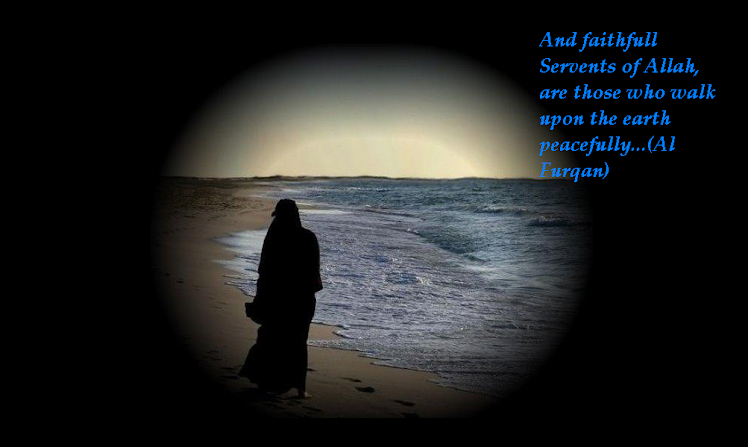
Tuesday, February 10, 2009

Learn About Allah, The One and Only God, The Creator and Sustainer of the universe.

***Learn About Allah, The One and Only God, The Creator and Sustainer of the universe.***

Allah: الله Allah is the proper name in Arabic for The One and Only God, The Creator and Sustainer of the universe. It is used by the Arab Christians and Jews for the God (Eloh-im in Hebrew; 'Allaha' in Aramaic, the mother tongue of Jesus, pbuh). The word Allah does not have a plural or gender. Allah does not have any associate or partner, and He does not beget nor was He begotten.
The Name Allah was not chosen by man but was revealed and referred to by all the Prophets (peace be on them). Allah was the God worshipped by Adam, Noah, Moses, Abraham and all the other Prophets sent by him.
The name “Allah” consists of two parts, “Al” which is the definitive article in Arabic and “ilah” which means an object to which subservience, love, reverence, and obedience is shown. Being a combination of these two parts, “Allah” signifies the one and only God, the one whom absolute love, reverence and obedience is shown.
One misconception is that Allah is a new or different deity than that mentioned in the Bible or Torah. However, Arab Christians use this word too, and instead of the English word "God" it is Allah which is used in their bible, prayers and daily rituals. In fact, if they did not know English, they would not know who or what a "God" in the English sense was, as they are accustomed to the use of “Allah”. Nor do they use the word "Jesus", but the same word in Arabic for Jesus which is Isa.
However, the Arab Christians share the same belief about God as other Christians around the world, i.e. that Jesus was his son and the incorrect belief in the Trinity. These beliefs are contrary to those of Islam. As Muslims, we believe that these beliefs are not what Jesus or Gods message in the Bible were intended to be. Allah is the same God that Adam, Noah, Abraham, Moses and Jesus worshipped. Furthermore, Islam was the exact same message that was followed and taught by all the Prophets. And they are far from the erroneous and fabricated claims that the Christians and Jews make about them.
{No son (or offspring or children) did Allâh beget, nor is there any ilâh (god) along with Him; (if there had been many gods), behold, each god would have taken away what he had created, and some would have tried to overcome others! Glorified be Allâh above all that they attribute to Him!} [Quran, 23:91]He is AllaahThe First: Nothing is before Him.The Last: Nothing is After Him.The Most High: Nothing is Above Him.The Most Near: Nothing is beyond His Reach.He Begets Not, Nor was He Begotten.The Creator, Provider, and All-Rich.The All-Seer, The All-Knower.He is One and Self-Sufficient.He is not Nature, or any part of it.He ascended above His Throne, High above the Seven Skies.No Vision can encompass Him, butHis Grasp is over all vision...Who is Allah?[ Say:
"He is Allaah, {the} One. "Allaah
us-Samad {self-Sufficient}. "He begets not, nor was He begotten; "And there is none co-equal or comparable unto Him."] Soorat Al Ikhlaas {112:1-4}
[ Allaah is He Who has created the heavens and the earth and sends down water from the sky, and thereby brought forth fruits as provision for you; and He has made the ships to be of service to you, that they may sail through the sea by His Command; and He has made rivers {also} to be of service to you.] Soorat Ibraheem {14:32}
[ And it is He Who spread out the earth, and placed therein firm mountains and rivers and of every kind of fruits He made Zawjain Ithnain {two in pairs - may mean two kinds or it may mean: of two sorts, e.g. black and white, sweet and sour, small and big, etc.} He brings the night as a cover over the day. Verily, in these things, there are aayaat {proofs, evidences, lessons, signs, revelation, etc.} for people who reflect.]
Soorat Ar Ra'd {13:3}
[ Allaah is He Who created you, then provided food for you, then will cause you to die, then {again} He will give you life. Is there any of your {so-called} partners {of Allaah} that do anything of that? Glory be to Him! And Exalted be He above all that {evil} they associate {with Him}.] Soorat Ar Ruum {30:40}
[ And He has made the sun and the moon, both constantly pursuing their courses, to be of service to you; and He has made the night and the day, to be of service to you.] Soorat Ibraheem {14:33}
[ And He gave you of all that you asked for, and if you count the Blessings of Allaah, never will you be able to count them. Verily! Man is indeed an extreme wrong-doer, - a disbeliever {an extreme ingrate, denies Allaah's Blessings by disbelief, and by worshipping others besides Allaah, and by disobeying Allaah and His Prophet Muhammad }.] Soorat Ibraheem {14:34}
[ See they not that Allaah, Who created the heavens and the earth, is Able tocreate the like of them. And He has decreed for them an appointed term, whereofthere is not doubt. But the Dhalimeen {polytheists, oppressors, unjust, andwrong-doers, etc.} refuse {the truth the Message of Islamic Monotheism, andaccept nothing} but disbelief.] Soorat Al Israa {17:99}
[ Your Ilah {God} is only Allaah, the One. He has full knowledge of all things.]
Soorat Ta Ha {20:98}
[ Allaah is the Light of the heavens and the earth. The parable of His Light is as {if there were} a niche and within it a lamp, the lamp is in glass, the glass as it were a brilliant star, lit from a blessed tree, an olive, neither of the East {i.e. neither it gets sun-rays only in the morning} nor of the West {i.e. nor it gets sunrays only in the afternoon, but it is exposed to the sun all day long}, whose oil would almost glow forth {of itself}, though no fire touched it. Light upon Light! Allaah guides to His Light whom He wills. And Allaah sets forth parables for mankind, and Allaah is All-Knower of everything.] Soorat An Nuur {24:35}
[ Allaah is He Who sends the winds, so they raise clouds, and spread them along the sky as He wills, and then break them into fragments, until you see rain drops come forth from their midst! Then when He has made them fall on whom of His slaves as He will, lo! they rejoice!] Soorat Ar Ruum {30:48}
[ Allaah is He Who created you in {a state of} weakness, then gave you strength after weakness, then after strength gave {you} weakness and grey hair. He creates what He wills. And it is He Who is the All-Knowing, the All-Powerful {i.e. Able to do all things}.] Soorat Ar Ruum {30:54}
[ Allaah it is He Who has created the heavens and the earth, and all that is between them in six Days. Then He Istawa {rose over} the Throne {in a manner that suits His Majesty}. You {mankind} have none, besides Him, as a Wali or an intercessor. Will you not then remember {or be admonished}Soorat As Sajdah{32:4}
[ Allaah, it is He Who has made the night for you that you may rest therein and the day for you to see. Truly, Allaah is full of Bounty to mankind, yet most of mankind give no thanks.]
Soorat Ghaafir {40:61}
[ Allaah, it is He Who has made for you the earth as a dwelling place and the skyas a canopy, and has given you shape and made your shapes good {looking} andhas provided you with good things. That is Allaah, your Lord, then blessed beAllaah, the Lord of the 'alameen {mankind and jinns}.] Soorat Ghaafir {40:64}[ Allaah it is He Who has subjected to you the sea, that ships may sail through itby His Command, and that you may seek of His Bounty, and that you may bethankful,] Soorat Al Jaathiya {45:12}
[ And has subjected to you all that is in the heavens and all that is in the earth; itis all as a favour and kindness from Him. Verily, in it are signs for a people whothink deeply.] Soorat Al Jaathiya {45:13}
[ Do they not see that Allaah, Who created the heavens and the earth, and wasnot wearied by their creation, is Able to give life to the dead? Yes, He surely isAble to do all things.] Soorat Al Ahqaaf {46:33}[ He is Allaah, than Whom there is
laa ilaaha illa huwa {none deserves to beworshiped but He} the All-Knower of the unseen and the seen {open}. He is theMost Beneficent, the Most Merciful.] Soorat Al Hashr {59:22}
[ He is Allaah than Whom there is laa ilaaha illa Huwa {none deserves to beworshiped but He} the King, the Holy, the One Free from all defects, the Giver ofsecurity, the Watcher over His creatures, the All-Mighty, the Compeller, theSupreme. Glory be to Allaah! {High is He} above all that they associate aspartners with Him.] Soorat Al Hashr {59:23}
[ He is Allaah, the Creator, the Inventor of all things, the Bestower of forms. ToHim belong the Best Names. All that is in the heavens and the earth glorify Him.
And He is the All-Mighty, the All-Wise.]
Soorat Al Hashr {59:24}
[ It is Allaah Who has created seven heavens and of the earth the like thereof {i.e.seven}. His Command descends between them {heavens and earth}, that you may
know that Allaah has power over all things, and that Allaah surrounds
{comprehends} all things in {His} Knowledge.]
Soorat At Talaaq {65:12}
[ Allaah! Laa ilaaha illa Huwa {none deserves to be worshiped but He}, the EverLiving, the One Who sustains and protects all that exists. Neither slumber, norsleep overtake Him. To Him belongs whatever is in the heavens and whatever is
on earth. Who is he that can intercede with Him except with His Permission? Heknows what happens to them {His creatures} in this world, and what will happento them in the Hereafter. And they will never compass anything of HisKnowledge except that which He wills. His Kursi extends over the heavens andthe earth, and He feels no fatigue in guarding and preserving them. And He isthe Most High, the Most Great.] Soorat Al Baqarah {2:255}[ Truly, nothing is hidden from Allaah, in the earth or in the heavens.He it is Who shapes you in the wombs as He pleases. Laa ilaaha illa Huwa {none deservesto be worshiped but He}, the All-Mighty, the All-Wise.]
Soorat Aal 'Imraan {3:5-6}
[ Allaah! laa ilaaha illa Huwa {none deserves to be worshiped but He}. Surely, He will gather you together on the Day of Resurrection about which there is no doubt. And who is truer in statement than Allaah?] Soorat An Nisa{4:87}
[ Allaah! laa ilaaha illa Huwa! {none deserves to be worshiped but He} To Him belong the Best Names.] Soorat Ta Ha {20:8}
[ "Verily! I am Allaah! laa ilaaha illa Ana {none deserves to be worshiped butMe}, so worship Me, and perform As-Salat for My Remembrance]
Soorat Ta Ha {20:14}
[ And He is Allaah; laa ilaaha illa Huwa {none deserves to be worshiped but He}.His is all praise, in the first {i.e. in this world} and in the last {i.e.in theHereafter}. And for Him is the Decision, and to Him shall you {all} be returned.]
Soorat Al Qasas {28:70}
[ "But as for my part {I believe} that He is Allaah, my Lord and none shall I
associate as partner with my Lord. It was better for you to say, when you enteredyour garden: "That which Allaah wills {will come to pass}! There is no power
but with Allaah". If you see me less than you in wealth, and children.]
Soorat Al Kahf {18:38-39}
[ Say {to these polytheists and pagans}: "Show me those whom you have joinedto Him as partners. Nay {there are not at all any partners with Him}! But He isAllaah {Alone}, the All-Mighty, the All-Wise."] Soorat Sabaa {34:27}
[ He has created the heavens and the earth with truth. He makes the night to goin the day and makes the day to go in the night. And He has subjected the sunand the moon. Each running {on a fixed course} for an appointed term. Verily,He is the All-Mighty, the Oft-Forgiving.] Soorat Az Zumar {39:5}
Your Lord is Allaah, So Worship None But Him
[ "Allaah, your Lord and the Lord of your forefathers."] Soorat As Saffat {37:126}
[ He created you {all} from a single person {Adam}; then made from him his wife[Hawwa {Eve}]. And He has sent down for you of cattle eight pairs {of the sheep,two, male and female; of the goats, two, male and female; of the oxen, two, male and female; and of the camels, two, male and female}. He creates you in thewombs of your mothers, creation after creation in three veils of darkness, such isAllaah your Lord. His is the kingdom, laa ilaaha illa Huwa {none deserves to beworshiped but He}. How then are you turned away?] Soorat Az Zumar {39:6}
[ If you disbelieve, then verily, Allaah is not in need of you, He likes not disbelieffor His slaves. And if you are grateful {by being believers}, He is pleased therewith for you. No bearer of burdens shall bear the burden of another. Then to your Lord is your return, so He will inform you what you used to do. Verily, He is the All-Knower of that which is in {men's} breasts.] Soorat Az Zumar{39:7}[ Laa ilaaha illa Huwa {none deserves to be worshiped but He}. It is He Who gives life and causes death, your Lord and the Lord of your fore-fathers.] Soorat Ad Dukhaan {44:8}[ O mankind! Worship your Lord, Who created you and those who were before you so that you may become al-Muttaqeen {pious and righteous}.] Soorat AlBaqarah {2:21}
[ And will make him {'Eesaa, Jesus} a Messenger to the Children of Israel{saying}: "I have come to you with a sign from your Lord, that I design for youout of clay, as it were, the figure of a bird, and breathe into it, and it becomes abird by Allaah's Leave; and I heal him who was born blind, and the leper, and Ibring the dead to life by Allaah's Leave. And I inform you of what you eat, andwhat you store in your houses. Surely, therein is a sign for you, if you believe.]Soorat Aal 'Imraan {3:49}[ O mankind! Verily, there has come to you the Messenger with the truth from your Lord, so believe in him, it is better for you. But if you disbelieve, then certainly to Allaah belongs all that is in the heavens and the earth. And Allaah is Ever All-Knowing, All-Wise.] Soorat An Nisaa {4:170}
[ O mankind! Verily, there has come to you a convincing proof from your Lord, and We sent down to you a manifest light {this Quraan}. So, as for those who believed in Allaah and held fast to Him, He will admit them to His Mercy and Grace, and guide them to Himself by a Straight Path.] Soorat An Nisaa {4:174- 175}[ Such is Allaah, your Lord! Laa ilaaha illa Huwa {none deserves to be worshipped but He}, the Creator of all things. So worship Him {Alone}, and He is the Wakil {trustee, disposer of affairs, guardian, etc.} over all things.] Soorat Al An'aam {6:102}
[ No vision can grasp Him, but His Grasp is over all vision. He is the Most Subtle and Courteous, Well-Acquainted with all things.] Soorat Al An'aam {6:103}[ Verily, proofs have come to you from your Lord, so whosoever sees, will do so for {the good of} his ownself, and whosoever blinds himself, will do so to his own harm, and I am not a watcher over you.] Soorat Al An'aam {6:104}
[ Say: "Come, I will recite what your Lord has prohibited you from: join not anything in worship with Him; be good and dutiful to your parents; kill not your children because of poverty - We provide sustenance for you and for them; come not near to
al-Fawahish {shameful sins, illegal sexual intercourse, etc.} whether committed openly or secretly, and kill not anyone whom Allaah has forbidden, except for a just cause {according to Islamic law}. This He has commanded you that you may understand.] Soorat Al An'aam {6:151}
[ "And come not near to the orphan's property, except to improve it, until he {or she} attains the age of full strength; and give full measure and full weight with justice. We burden not any person, but that which he can bear. And whenever you give your word {i.e. judge between men or give evidence, etc.}, say the truth even if a near relative is concerned, and fulfill the covenant of Allaah, This He commands you, that you may remember."] Soorat Al An'aam {6:152}
[ "And verily, this {i.e. Allaah's Commandments mentioned in the above twoverses 151 and 152} is my Straight Path, so follow it, and follow not {other} paths, for they will separate you away from His Path. This He has ordained for you that you may become al-Muttaqeen {pious and righteous}."] Soorat Al An'aam {6:153}


Wednesday, January 28, 2009

CHARACTERISTICS OF PROPHET MOHAMMED S.A.W.S


CHARACTERISTICS OF PROPHET MOHAMMED S.A.W.S(Allahs mercy.love and blessings be upon him)


~His Appearance


Muhammad was of a height a little above the average.

He was of sturdy build with long muscular limbs and tapering fingers. The hair of his head was long and thick with some waves in them. His forehead was large and prominent, his eyelashes werelong and thick, his nose was sloping, his mouth was somewhat large and his teeth were well set.

His cheeks were spare and he had a pleasant smile. His eyes were large and black with a touch of brown.

His beard was thick and at the time of his death, he had seventeen gray hairs in it. He had a thin line of fine hair over his neck and chest.

His gait was firm and he walked so fast that others found it difficult to keep pace with him. His face was genial but at times, when he was deep in thought, there were long periods of silence, yet he always kept himself busy with something.

He did not speak unnecessarily and what he said was always to the point and without any padding. At times he would make his meaning clear by slowly repeating what he had said. His laugh was mostly a smile.

He kept his feelings under firm control - when annoyed, he would turn aside or keep silent, when pleased he would lower his eyes (Shamail Tirmizi).


~Dress Of Prophet Mohammed


His dress generally consisted of a shirt, tamad (trousers), a sheet thrown round the sholders and a turban.

On rare occasions, he would put on costly robes presented to him by foreign emissaries in the later part of his life (Ahmed, Musnad, Hafiz Bin Qaiyyam). His blanket had several patches (Tirmizi).

He had very few spare clothes, but he kept them spotlessy clean (Bukhari). He wanted others also to put on simple but clean clothes.

Once he saw a person putting on dirty clothes and remarked, "Why can't this man wash them." (Abu Dawud, Chapter "Dress"). On another occasion he enquired of a person in dirty clothes whether he had any income.

Upon getting a reply in the affirmative, he observed, "When Allah has blessed you with His bounty, your appearence should reflect it." (Abu Dawud) He used to observe: "Cleanliness is piety".


~Mode of Living Of Prophet Mohammed


His house was but a hut with walls of unbaked clay and a thatched roof of palm leaves covered by camel skin.

He had separate apartments for his wives, a small room for each made of similar materials. His own apartment contained a rope cot (1*), a pillow stuffed with palm leaves , the skin of some animal spread on the floor and a water-bag of leather and some weapons.

These were all his earthly belongings, besides a camel, a horse, and some land which he had aquired in the later part of his life. (Bukhari, Muslim, Abu Dawud). Once some of his disciples, noticing the imprint of his mattress on his body, wished to give him a softer bed, but he politely declined the offer saying, "What have I to do with worldly things.

My connection with the world is like that of a traveler resting for a while underneath the shade of a tree and then moving on."

Amr Ibn Al-Harith, a brother-in-law of the Prophet , says that when the Prophet died, he did not leave a cent, a slave man or woman, or any property except his white mule, his weapons and a piece of land which he had dedicated for the good of the community. (Sahih Bukhari).

He advised the people to live simple lives and himself practised great austerities. Even when he had become the virtual king of Arabia, he lived an austere life bordering on privation. His wife Ayesha (radiyallaahu `anha) says that there was hardly a day in his life when he had two square meals. (Sahih Muslim,, Vol.2, pg 198).

When he died there was nothing in his house except a few seeds of barley left from a mound of the grain obtained from a Jew by pawning his armour. (Bukhari, Sahih Bukhari, Chapter "Aljihad").

He had declared unlawful for himself and his family anything given by the people by way of zakat or sadaqa (types of charity). He was so particular about this that he would not appoint any member of his family as a zakat collector. (Sahah-Kitab Sadaqat).


~Hazrat Muhammad Manners and Disposition


"By the grace of Allah, you are gentle towards the people; if you had been stern and ill-tempered, they would have dispersed from round about you" (translation of Qur'an 3:159)

About himself the Prophet said "Allah has sent me as an apostle so that I may demonstrate perfection of character, refinement of manners and loftiness of deportment." (2*) (Malik, Mawatta; Ahmed, Musnad; Mishkat) By nature he was gentle and kind hearted, always inclined to be gracious and to overlook the faults of others. Politeness and courtesy, compassion and tenderness, simplicity and humility, sympathy and sincerity were some of the keynotes of his character.

In the cause of right and justice he could be resolute and severe but more often than not, his severity was tempered with generosity. He had charming manners which won him the affection of his followers and secured their devotion.

Though virtual king of Arabia and an apostle of Allah, he never assumed an air of superiority. Not that he had to conceal any such vein by practice and artifice: with fear of Allah, sincere humility was ingrained in his heart. He used to say,

"I am a Prophet of Allah but I do not know what will be my end." (Bukhari, Sahih Bukhari, Chapter "Al-Janaiz") In one of his sermons calculated to instill the fear of Allah and the Day of Reckoning in the hearts of men, he said, "O people of Quraish be prepared for the Hereafter, I cannot save you from the punishment of Allah; O Bani Abd Manaf, I cannot save you from Allah; O Abbas, son of Abdul Mutalib, I cannot protect you either; O Fatima, daughter of Muhammad, even you I cannot save." (Sahihain)

He used to pray, "O Allah! I am but a man. If I hurt anyone in any manner, then forgive me and do not punish me." (Ahmed, Musnad, Vol. 6 p. 103) He always received people with courtesy and showed respect to older people and stated: "To honor an old man is to show respect to Allah." He would not deny courtesy even to wicked persons. It is stated that a person came to his house and asked permission for admission.

The Prophet remarked that he was not a good person but might be admitted. When he came in and while he remained in the house, he was shown full courtesy. When he left Ayesha (radiyallaahu `anha) said, "You did not think well of this man, but you treated him so well." The Prophet replied, "He is a bad person in the sight of Allah who does not behave courteously and people shun his company because of his bad manners." (Bukhari, Sahih Bukhari)


He was always the first to greet another and would not withdraw his hand from a handshake till the other man withdrew his. If one wanted to say something in his ears, he would not turn away till one had finished (Abu Dawud, Tirmizi). He did not like people to get up for him and used to say, "Let him who likes people to stand up in his honour seek a place in hell." (Abu Dawud, Kitabul Adab, Muhammadi Press, Delhi). He would himself, however, stand up when any dignitary came to him. He had stood up to receive the wet-nurse who had reared him in infancy and had spread his own sheet for her. His foster-brother was given similar treatment. He avoided sitting at a prominent place in a gathering, so much so that people coming in had difficulty in spotting him and had to ask which was the Prophet . Quite frequently uncouth bedouins accosted him in their own gruff and impolite manner but he never took offence.(Abu Dawud Kitabul Atama). He used to visit the poorest of ailing persons and exhorted all Muslims to do likewise (Bukhari, Sahih Bukhari, Chapter "Attendance on ailing persons"). He would sit with the humblest of persons saying that righteousness alone was the criterion of one's superiority over another. He invariably invited people be they slaves, servants or the poorest believers, to partake with him of his scanty meals (Tirmizi, Sunan Tirmizi).

Whenever he visited a person he would first greet him and then take his permission to enter the house. He advised the people to follow this etiquette and not to get annoyed if anyone declined to give permission, for it was quite likely the person concerned was busy otherwise and did not mean any disrespect (Ibid). There was no type of household work too low or too undignified for him. Ayesha (radiyallaahu `anha) has stated, "He always joined in household work and would at times mend his clothes, repair his shoes and sweep the floor. He would milk, tether, and feed his animals and do the household shopping." (Qazi Iyaz: Shifa; Bukhari, Sahih Bukhari, Chapter: Kitabul Adab) He would not hesitate to do the menial work of others, particularly of orphans and widows (Nasi, Darmi).

Once when there was no male member in the house of the companion Kabab Bin Arat who had gone to the battlefield, he used to go to his house daily and milk his cattle for the inhabitants. (Ibn Saad Vol. 6, p 213).


~Prophet Mohammed And Children


He was especially fond of children and used to get into the spirit of childish games in their company. He would have fun with the children who had come back from Abyssinia and tried to speak in Abyssinian with them. It was his practice to give lifts on his camel to children when he returned from journeys.

(Bukhari, Sahih Bukhari, Vol. 2 p.886).


He would pick up children in his arms, play with them, and kiss them.


A companion, recalling his childhood, said, "In my childhood I used to fell dates by throwing stones at palm trees. Somebody took me to the Prophet who advised me to pick up the dates lying on the ground but not to fell them with stones. He then patted me and blessed me." (Abu Dawud)


~Daily Routine of Prophet Mohammed


On the authority of Ali (kaw), Tirmizi has recorded that the Prophet had carefully apportioned his time according to the demands on him for offering worship to Allah in and his personal matters.

After the early morning prayers he would remain sitting in the mosque reciting praises of Allah till the sun rose and more people collected. He would then preach to them. After the sermons were over, he would talk genially with the people, enquire about their welfare and even exchange jokes with them.

Taxes and revenues were also disrtibuted at this time (Sahih Muslim, Tirmizi, Sunan Tirmizi). He would then offer chaste prayers and go home and get busy with household work. (Bukhari, Muslim, Tirmizi). He would again return to the mosque for the mid-day and afternoon prayers, listen to the problems of the people and give solace and guidance to them.

After the afternoon prayers, he would visit each of his wives and, after the evening prayers, his wives would collect at one place and he would have his dinner. (Sahih Muslim,).

After the night prayers, he would recite some suras of the Quran and before going to bed would pray: "O Allah, I die and live with thy name on my lips." On getting up he would say, "All praise to Allah Who has given me life after death and towards Whom is the return."

He used to brush his teeth five times a day, before each of the daily prayers. After midnight, he used to get up for the tahajjud prayers which he never missed even once in his life. (Sahih Bukhari). He was not fastidious about his bed: sometimes he slept on his cot (1*), sometimes on a skin or ordinary matress, and sometimes on the ground (Zarqani). On friday he used to give sermons after the weekly "Jumu`a" prayers. He was not annoyed if anyone interrupted him during the sermons for anything. It is stated that once, while he was delivering his sermon, a bedouin approached him and said, "O messenger of Allah, I am a traveler and am ignorant of my religion."

The Prophet got down from the pulpit, explained the salient features of Islam to him and then resumed the sermon (Tirmizi, Sunan Tirmizi).

On another occasion his grandson Husain, still a child, came tumbling to him while he was delivering a sermon. He descended and took him in his lap and then continued the sermon (Ibid).


~Trust in Allah Subhanahu wah ta`ala


Muhammad preached to the people to trust in Allah Subhanahu wah ta`ala. His whole life was a sublime example of this precept. In the loneliness of Makkah, in the midst of persecution and danger, in adversity and tribulations, and in the thick of enemies in the battles of Uhud and Hunain, complete faith and trust in Allah Subhanahu wah ta`ala appears as the dominant feature in his life

. However great the danger that confronted him, he never lost hope and never allowed himself to be unduly agitated. Abu Talib knew the feelings of the Quraish when the Prophet started his mission. He also knew the lengths to which the Quraish could go, and requested the Prophet to abandon his mission, but the latter calmly replied, "Dear uncle, do not go by my loneliness. Truth will not go unsupported for long.

The whole of Arabia and beyond will one day espouse its cause." (Ibn Hisham, Sirat-ur-Rasul.) When the attitude of the Quraish became more threatening, Abu Talib again begged his nephew to renounce his mission but the Prophet's reply was: "O my uncle, if they placed the sun in my right hand and the moon in my left, to force me to renounce my work, verily I would not desist thereform until Allah made manifest His cause, or I perished in the attempt." (Ibid) To another well-wisher, he said, "Allah will not leave me forelorn." A dejected and oppressed disciple was comforted with the words: "By Allah, the day is near when this faith will reach its pinnacle and none will have to fear anyone except Allah." (Sahih Bukhari) It was the same trust in Allah Subhanahu wah ta`ala which emboldened the Prophet to say his prayers openly in the Harâm in the teeth of opposition.

The Quraish were once collected there and were conspiring to put an end to his life the next time he entered the Harâm.

His young daughter Fatima, who happened to overhear their talk rushed weeping to her father and told him of the designs of the Quraish. He consoled her, did his ablutions and went to the Kaaba to say prayers. There was only consternation among the Quraish when they saw him. (Ahmed, Musnad, Vol. 1, p. 368). Then leaving his house for Madinah he asked Ali (radiyallaahu `anhu) to sleep on his bed and told him, "Do not worry, no one will be able to do you any harm" (Tabari, Ibn Hisham) Even though the enemies had surrounded the house, he left the house reciting the Quranic verse: "We have set a barricade before them and a barricade behind them and (thus) have covered them so that they see not" (translation of Qur'an 36:9) Abu Bakr (radiyallaahu `anhu) was frightened when pursuers came close to the cavern in which he and Prophet Muhammad were hiding during their flight, but the Prophet heartened him, "Grieve not. Allah is with us." A guard was kept at the Prophet's house in Madinah because of the danger that surrounded him but he had it withdrawn when the Quranic verse was revealed: "Allah will protect you from the people" (translation of Qur'an 5:67). A man was caught waiting in ambush to assault the Prophet but he was directed to be released with the words, "Even if this man wanted to kill me, he could not." (Ahmed, Musnad, Vol.3 p. 471) A Jewess from Khaibar had put poison in the Prophet's food. He spat it out after taking a morsel but a disciple who had his fill died the next day. The Jewess was brought before the Prophet who questioned her: "Why did you do this?" "To kill you," was her defiant reply. She was told, "Allah would not have allowed you to do it." (Sahih Muslim,.) I

n the battle of Uhud when the rear guard action of the Makkan army had disorganized the Muslim army and had turned the tables, the Prophet stood as firm as a rock even though he had suffered personal injuries. When Abu Sufiyan taunted the Muslims and shouted "Victory to hubal!" (hubal was one of their idols), the Prophet asked Umar (radiyallaahu `anhu) to shout back, "Allah is our protector and friend. You have no protector and friend. Allah is Great, Magnificent." (Ibn Hisham, Sirat-Ur-Rasul). Again in the battle of Hunain, when the unexpected assault of the army had swept the Muslim force off its feet and a defeat seemed imminent, the Prophet did not yield ground. With trust in Allah (swt) he showed such courage that the Muslim army rallied behind him to win a signal victory.


~Justice Of Prophet Mohammed


The Prophet asked people to be just and kind. As the supreme judge and arbiter (3*), as the leader of men, as generalissimo of a rising power, as a reformer and apostle, he had always to deal with men and their affairs.

He had often to deal with mutually inimical and warring tribes when showing justice to one carried the danger of antagonizing the other, and yet he never deviated from the path of justice. In administering justice, he made no distinction between believers and nonbelievers, friends and foes, high and low.

From numerous instances reported in the traditions, a few are given below. Sakhar, a chief of a tribe, had helped Muhammad greatly in the seige of Taif, for which he was naturally obliged to him.

Soon after, two charges were brought against Sakhar: one by Mughira of illegal confinement of his (Mughira's) aunt and the other by Banu Salim of forcible occupation of his spring by Sakhar. In both cases, he decided against Sakhar and made him undo the wrong. (Abu Dawud, Sunan Dawud, p.80) Abdullah Bin Sahal, a companion, was deputed to collect rent from Jews of Khaibar.

His cousin Mahisa accompanied him but, on reaching Khaibar, they had separated. Abdullah was waylaid and done to death. Mahisa reported this tragedy to the Prophet but as there were no eye-witnesses to identify the guilty, he did not say anything to the Jews and paid the blood-money out of the state revenues. (Bukhari, Sahih Bukhari Nasai). A woman of the Makhzoom family with good connections was found guilty of theft. For the prestige of the Quraish, some prominent people including Asama Bin Zaid interceded to save her from punishment. The Prophet refused to condone the crime and expressed displeasure saying, "Many a community ruined itself in the past as they only punished the poor and ignored the offences of the exalted. By Allah, if Muhammad's (my) daughter Fatima would have committed theft, her hand would have been severed." (Bukhari, Sahh Bukhari, Chapter "al-hudûd") The Jews, in spite of their hostility to the Prophet , were so impressed by his impartiallity and sense of justice that they used to bring their cases to him, and he decided them according to Jewish law. (Abu Dawud, Sunan Dawud) Once, while he was distributing the spoils of war, people flocked around him and one man almost fell upon him. He pushed the men with a stick causing a slight abrasion.

He was so sorry about this that he told the man that he could have his revenge, but the man said, "O messenger of Allah, I forgive you." (Abu Dawud, Kitablu Diyat).

In his fatal illness, the Prophet proclaimed in a concourse (4*) assembled at his house that if he owed anything to anyone the person concerned could claim it; if he had ever hurt anyone's person, honor or property, he could have his price while he was yet in this world. A hush fell on the crowd. One man came forward to claim a few dirhams which were paid at once. (Ibn Hisham, Sirat-ur-Rasul)


~His Sense for Equality


Hazrat Muhammad asked people to shun notions of racial, family or any other form of superiority based on mundane things and said that righteousness alone was the criterion of one's superiority over another.

It has already been shown how he mixed with everyone on equal terms, how he ate with slaves, servants and the poorest on the same sheet (a practice that is still followed in Arabia), how he refused all privileges and worked like any ordinary laborer.

Two instances may, however, be quoted here: Once the Prophet visited Saad Bin Abadah. While returning Saad sent his son Quais with him. The Prophet asked Quais to mount his camel with him. Quais hesitated out of respect but the Prophet insisted: "Either mount the camel or go back." Quais decided to go back. (Abu Dawud, Kitabul Adab) On another occasion he was traveling on his camel over hilly terrain with a disciple, Uqba Bin Aamir. After going some distance, he asked Uqba to ride the camel, but Uqba thought this would be showing disrespect to the Prophet . But the Prophet insisted and he had to comply.

The Prophet himself walked on foot as he did not want to put too much load on the animal. (Nasai p. 803)

The prisioners of war of Badr included Abbas, the uncle of the Prophet . Some people were prepared to forgo their shares and remit the Prophet's ransom but he declined saying that he could make no distinctions. (Bukhari, Sahih Bukhari, Chapter "Ransoms") During a halt on a journey, the companions apportioned work among themselves for preparing food.

The Prophet took upon himself the task of collecting firewood. His companions pleaded that they would do it and that he need not take the trouble, but he replied, "It is true, but I do not like to attribute any distinction to myself. Allah does not like the man who considers himself superior to his companions." (Zarqani, Vol 4 p. 306)


~His Kindness to Animals


If he saw any animal over-loaded or ill-fed he would pull up the owner and say, "Fear Allah in your treatment of animals." (Abu Dawud, Kitab Jihad).


~His Love for the Poor


The Prophet enjoined upon Muslims to treat the poor kindly and to help them with alms, zakat, and in other ways. He said: "He is not a perfect Muslim who eats his fill and lets his neighbor go hungry." He asked, "Do you love your Creator? Then love your fellow beings first." Monopoly is unlawful in Islam and he preached that "It is diffucult for a man laden with riches to climb the steep path that leads to bliss." He did not prohibit or discourage the aquisition of wealth but insisted that it be lawfully aquired by honest means and that a portion of it would go to the poor. He advised his followers "to give the laborer his wages before his perspiration


Monday, January 5, 2009

YOUR FRIEND


Asalamu alaykum


One of my friends sent this to me and I thought it might brighten you as it did to me so i hope you all enjoy it.

As you got up this morning, I watched you, and hoped you would talk to me, even if it was just a few words, asking my opinion or thanking me for something good that happened in your life yesterday. But I noticed you were too busy, trying to find the right outfit to wear. When you ran around the house getting ready, I knew there would be a few minutes for you to stop and say hello, but you were too busy. At one point you had to wait, fifteen minutes with nothing to do except sit in a chair. Then I saw you spring to your feet. I thought you wanted to talk to me, but you ran to the phone and called a friend to get the latest gossip instead. I watched patiently all day long. With all your activities I guess you were too busy to say anything to me. I noticed that before lunch you looked around, may be you felt embarrassed to talk to me, that is why you didn't bow your head. You glanced three or four tables over and you noticed some of your friends talking to me briefly before they ate, but you didn't. That's okay. There is still more time left, and I hope that you will talk to me yet. You went home and it seems as if you had lots of things to do. After a few of them were done, you turned on the TV. I don't know if you like TV or not, just about anything goes there and you spend lot of time each day in front of it not thinking about anything, just enjoying the show. I waited patiently again as you watched the TV and ate your meal, but again you didn't talk to me. Bedtime I guess you felt too tired. After you said good night to your family you popped into bed and fell asleep in no time. That's okay because you may not realize that I am always there for you. I've got patience, more than you will ever know. I even want to teach you how to be patient with others as well. I love you so much that I wait everyday for a nod, prayer or thought or a thankful part of your heart. It is hard to have a one-sided conversation. Well, you are getting up once again. And once again I will wait, with nothing but love for you. Hoping that today you will give me some time. Have a nice day!


Your friend, ALLAH


PS - Do you have enough time to send this to another person?


Saturday, November 29, 2008

ISLAMIC(HALAL) BANKING


Islamic (halal) banking and its importance


In the lately time are growing informations about Islamic banking and Islamic finansial sevrices which are practing trough models of Islamic banking,Islamic insurance,Islamic investment fonds and emision of halal share(part)

Islamic banking is based on Sharia(islamic low),not existing of interests ,devision of risk trough banking betwen Bank and its clients,services by Shariah Low,and its influence on Economy,bank like partner in all bussiness actions and importance those princips for Muslims and islam and garating of keeping halal properies.


-Not existing of interests


Islamic banks,like all other banks have their role of agency betwen thrifty cliant and investor.

Thier principal role is to take and keep propeties of cliants trough giving diffrents kind of services for thrifty clients and investing and on that way creating of property which will after be used for diffrent kind of investment enterprises.

Than in what is diffrence betwnen Islamic and other banks???

That difference could be desribed in diffrente levels whcih mean diffrence in the basic princip of bussines,clients,the way of taking and keeping properties,so as in way investing those properies in diffrente bussines projects.

In Islamic banking the money is not cosider like goods,so like that it can not be offer.Other banks are offering money like principal good and the prise of that good is interest who is paying the cliente of that bank.

Islamic abnks are offering the goods like principal way of satisfaing the necesery of thier cliants trough models which are permisible with Shraih Low.

Those models are based on:

-mudareb(partnership)

-Musharek(common bussiness project)

-marabeh(baying-selling models)

-selem(baying in advance)

-ijara wa iktina(leasing)

-qard al-hasen(kredits without interest


The most of services which Islamic banks are offering is based on partnership betwen Bank and her clients,where bank is sharing the resolt of bussines project and it is sharing risk with her clients.

Islamic banks are offering the equel rights to all cleints which shws and pruve that thier idea is valuable for ivesting.no metter do they have property with they could get back money in the way of mortgage on his property.


-Our halal alternative


On of the most importante thing for every Muslim is his property because he will be responable in front of Allah Subane we teal for the way on which he acquire thar property,the way how he spend it and the way how he multiply that property.

Shariah statment is very clear:"It is forbiden to give or to take interest" And on thart princip are based all Islamic banks.

Neither one bank is garanting to you that money which you are keeping on your account will not be used for production of alcohol,for gambling.....etc,but in onother side Islamic bank is garanting you that.

All other which is above mentioned is showing to us that Islamic banking is our halal alternative,which is also giving us oportunity to keep and multiply our property on halal way.


Friday, November 28, 2008

HIJAB;THE SIMBOL OF ISLAM AND MUSLIMA!!!

In the Holy Quran Allah sais:"And to lift down thier veils"

Design by:Asja


Wednesday, November 26, 2008

Palastine,the land of light!!!


~~~ Palastine,the land of light~~~

Palastine,the land of light
is it the same the Sun which is bringting you,
is the sky over Qudsa still so beautiful,
is it olive tree still the same colour,
is is Sinay mountain on the same place.
Are Mosques beautiful as before ,
is Zeytun hill still the hill and is there a place
for all of us becasue to everyone are the same
sunrises and apearing the downs,only people
love them diffrent.
***

I do not know Palastine yours long distances,
but I wish to see the sky over Qudsa,to see
Beytul-l-Magdis and Sinay mountain,I want to see
the Sun of Palastine,to pray there where oure souls are
servents and to see lands of Sham which are friends with you
Holy Palastine and I want to wach you but they are not
leting me.They say that my place is there and your light
is neer to me and Quds yours is neer to me.
So I am asking those who loves you,
do they hear your cry.
***

Do you feel Omer how hands are in chens of Palastine,
how hards are stones on inoccent children.Do you hear Eyub
the call of those who suffer.Do you hear how Palastine is crying,
how Quds is calling you that you bring piece on them
with holy selam,do you hear Eyube the call of Palastine.
***

They are waiting for you,oh Isa a.s the God Messanger,
Generous souls are looking for you.The eyes of Palastine
are directed to the sky,her eyes are sad,crying she is calling you,
Oh Isa the God Messanger.
***

Great are suffers of you Palastine,and people in three Ummah
are walking on your land.Bring them in peace with your Holyest
becasue your Holyest none can not destroy,neither killing,
niether sandess or pain,nither black neither white,
neither these,neither those one becasue on your land Ibrahim a.s. walked,
and over your sky Mohammed a.s. walked and do not cry Holy land
becasue you have Your Lord like all of us and all preise belongs only to Him,
to Allah Almighty.And He made you to be Holy land,Oh Palastine the land of light.
***

Written by:Asja


Sunday, August 31, 2008

The effects of Holy Quran upon the Hearts of People!!!


The Prophet [sall-Allaahu ‘alayhi wa sallam] said: “Allaah did not send any Messenger to a people except that He sent him with something through which people would believe in him.” When Allaah [subhaanahu wa ta’aala] sends a Messenger, He sends him with a miracle or something that is amazing that people cannot reproduce and that is suitable for that time.

If we look at the example of Moosaa [‘alayhi-sallam], we find that he was sent with a staff that was used for and turned into a snake, since in that time magic was wide spread.


If we look to ‘Isa [‘alayhi-sallam], his time was famous for practicing medicine and finding cures for different diseases, so Allaah [subhaanahu wa ta’aala] sent him with that ability [by His will] to cure the lepers, the blind and the deaf.


One of the greatest miracles that the Prophet [sall-Allaahu ‘alayhi wa sallam] was sent with is the Qur’aan. It is the miracle that will remain until nobody believes in Allaah and it is the miracle with which Allaah [subhaanahu wa ta’aala] challenged the Jinn and Mankind to produce the like thereof. Allaah described it as:“[This is] a Book [the Qur’aan] which We have sent down to you, full of blessings that they may ponder over its Verses, and that men of understanding may remember.” [Sad 38:29]


Before the Qur’aan was sent, at that time the Prophet [sall-Allaahu ‘alayhi wa sallam] lived in a time in which the Arabs used to pride themselves on their eloquence and they used to gather in their seasonal markets and recite poems to each other. A poet would come and recite a poem consisting of 100 or 200 lines and people would go home having memorised the entire poem, and they used to take pride in that. Allaah [subhaanahu wa ta’aala], challenged the Jinn and Mankind, after revealing it, to reproduce anything that is similar or the like of the Qur’aan and He challenged them by saying:“Say: ‘If the Mankind and the Jinn’s were together to produce the like of this Qur’aan, they could not produce the like thereof, even if they helped one another’.” [Al-Isra 17:88]


In order for us to appreciate and truly understand the greatness of the Qur’aan, we need to ponder and reflect over those verses in which Allaah challenged the Jinn and Mankind to bring the following: We have different degrees of that challenge, starting with the verses we just mentioned [above], Allaah said that they are not able to bring a whole book that resembles the Qur’aan, since they were not able to do it to that degree, Allaah [subhaanahu wa ta’aala] lessened the challenge and He [subhaanahu wa ta’aala] said: “Say: ‘Bring you then ten forged Surah [chapters] like unto it’.” [Hud 11:13]The challenge was reduced from the whole book to ten chapters like that of the Qur’aan.

Allaah [subhaanahu wa ta’aala] then challenged anyone to bring just one chapter like a chapter in the Qur’aan, and that the word chapter here is indefinite which from Arabic Grammar implies any chapter, short or long. And then lastly Allaah [subhaanahu wa ta’aala] said: “...then produce a Surah [chapter] of the like thereof...” [Al-Baqarah 2:23]Meaning that since you have not been able to bring anything like that of the above then something close to any chapter, but nobody from mankind or from the Jinn was or has been able to achieve this. Does that not prove beyond any doubt that this Book is indeed very great because nobody has been able to meet the challenge? This also proves to us that this Book, as Allaah [subhaanahu wa ta’aala] said, is from the Revelation of the One Who is Wise and the One who is All-Aware of everything. The greatness of the Qur’aan is shown by the fact that even Non-Muslims may [come to] realise its greatness, even though they may not understand the meaning of the Qur’aan they may still find its greatness. Unfortunately, as Muslims, sometimes we may not appreciate the greatness of the Qur’aan.

When the Prophet [sall-Allaahu ‘alayhi wa sallam] was in Makkah, the people gave him an offer, they said: “Oh Muhammad, if you want wealth or money we will give it to you, if you want women we will marry you to the most beautiful women of the Arabs, and if you want to rule us, we will give you the kingdom, just leave what you are doing and stop calling the people to Allaah [to tawheed].” After which the Prophet [sall-Allaahu ‘alayhi wa sallam] said: “Have you finished?” And this shows the manners of the Prophet [sall-Allaahu ‘alayhi wa sallam] to a Non-Muslim who is calling him to disbelief, he did not interrupt him until he finished and asked him: “Have you finished”, and the man stated that he had.


Then the Prophet [sall-Allaahu ‘alayhi wa sallam], started reciting Surah Fussilat in reply to his offer, and he kept reciting until he reached the saying of Allaah:“But if they turn away, then say [O Muhammad]: ‘I have warned you of a Saa’iqah [a destructive awful cry, torment, hit, a thunderbolt] like the Saa’iqah which overtook 'Ad and Thamood [people]’.” [Fussilat 41:13]When he [sall-Allaahu ‘alayhi wa sallam] reached the above verse, the man who had come to negotiate and make an offer, he said: “Enough O Muhammad, enough O Muhammad.” He could understand the meaning [of what was being recited] and he became affected by it


.Another example is the story of Jibrayah Muta’im. Before [his reversion to] Islam the disbelievers of Makkah waged a public relations war on the Prophet [sall-Allaahu ‘alayhi wa sallam]. They used to tell everyone not to listen to him and spread propaganda claiming that he [sall-Allaahu ‘alayhi wa sallam] was magician, a poet etc., despite this, Jibrayah Muta’im went to see the Prophet [sall-Allaahu ‘alayhi wa sallam] and he saw him praying near the Ka’bah. The Prophet [sall-Allaahu ‘alayhi wa sallam] [after Maghrib] was reciting Surah at-Tur, and he said: “When he reached: ‘Were they created by nothing, or were they themselves the creators?’ [At-Tur 52:35]I thought my heart was going to fly out of my body.”


One of my friends was studying in America. He was travelling on a bus and he was reciting Surah ad-Dhua. An American woman heard him, approached him and asked: “What are you reciting?” He said: “This is the Book of Allaah, I am reciting the Qur’aan.” She said: “This attracted me can you recite it again?” So the brother started to recite Surah Zalzalah, the women said: “This is not what you recited before but it is still nice, could you give me something that I can benefit from, like a tape or something I can listen to?” The brother went and he forgot, but when she saw him again [on the bus] she reminded him: “Remember you promised to give me a tape.” He said: “I searched through my sound library but I only found a tape by Shaykh Ali ‘Abdullaah Jaabir, which was recorded in a studio as opposed to the Masjid in Makkah. There is a difference because the recitation in the Masjid in Makkah is generally more beautiful, but inshaa’Allaah she will be affected by it!” He gave her the tape. After three months they met again and she said: “There has not been a single night from that time until now except that every single night I listened to this tape, and when I tried to go to bed without this tape I couldn’t do it.” This woman didn’t even know the difference between Alif, Baa and Taa, so how comes it affects the Non-Muslims and many times it does not affect us, the Muslims?Imaam al-Qurtubi [rahimahullaah] related a story in which he said: In that time it was the custom of the rulers to gather yearly and to have meetings.


They would invite the scholars and the people of knowledge so that the meetings would be full of knowledge. There was a man in that gathering who could speak Arabic well and it was said to the ruler that this individual is not actually a Muslim, he is a Jew. He [the ruler] was surprised and so he said to him: “Why don’t you become a Muslim and I will give you something to strengthen you in Islam, like some money or something material?” But he [the Jewish man] said: “This is the religion of my forefathers and so I will stay on it.” When the next years gathering was taking place, the same man was in the gathering and so the ruler looked at him and said: “Are you the same man I saw last year?” It appeared that the man had embraced Islam, and so he asked him: “Have you embraced Islam?” He said: “Yes!” The ruler asked him: “What made you embrace Islam?” He replied: “I am a man with very good handwriting so I decided to try the three books, the Torah, the Bible and the Qur’aan, to see which one of them is the truth. I copied three copies of the Torah with my nice handwriting and I added things to it from myself and I took some things out of it myself, and I took it to the market and decided to sell it, and the people bought all of them from me, so I knew that the religion [of Judaism] is false.” He did the same with the Bible and the same happened, he did the same with the Qur’aan and nobody bought a single copy from him because they realised that this was not the true Qur’aan, he said: “Then I knew that this is the true religion and I embraced Islam.”A great scholar was at that gathering by the name and when he heard the story [of the man’s reversion]; he addressed the ruler and informed him that there is what confirms to what he has just said in the Qur’aan, in Surah al-Ma’idah. Allaah [subhaanahu wa ta’aala] says: “And the rabbis and the priests [too judged the Jews by the Tauraat [Torah] after those Prophets] for to them was entrusted the protection of Allaah’s Book, and they were witnesses thereto. Therefore fear not men but fear Me [O Jews] and sell not My Verses for a miserable price.” [Al-Ma’idah 5:44]And:“It is We Who have sent down the Dhikr [i.e. the Qur’aan] and surely, We will guard it [from corruption].” [Al-Hijr 15:9]


So Allaah took it upon himself to protect the Qur’aan and with everything that has been mentioned, unfortunately, many of us have abandoned the Qur’aan and we do not treat it seriously, nor do not study it. The Messenger [sall-Allaahu ‘alayhi wa sallam] said:“Indeed my people have abandoned this Qur’aan.” Abandoning the Qur’aan can take different shapes and forms:First of all, not reciting it regularly, maybe we do not recite the Qur’aan for a few days in a row; perhaps we do not even recite the Qur’aan for several weeks.Secondly, we may recite it but we may not reflect on what we recite.Thirdly, we may leave acting upon the Qur’aan, what it makes Halaal and what it makes Haraam. Fourthly, we may abandon treating one another with the Qur’aan. Finally, we may even abandon taking the Qur’aan as our judge between us.So if you have abandoned the Qur’aan, then which type of abandonment have you fallen into? We must be very careful not to fall into that du’aa in which the Prophet [sall-Allaahu ‘alayhi wa sallam] said to Allaah that his people have abandoned the Qur’aan.There is a great hadeeth in the Musnad of Imaam Ahmad [rahimahullaah] stating that the Qur’aan is the accepted intercessor, meaning that when it defends someone and intercedes for that person, Allaah accepts its intercession, and a defender who is believed, when the Qur’aan defends someone Allaah believes and accepts their defence. Whoever puts the Qur’aan in front of him, the Qur’aan will take him to Paradise, and whoever puts the Qur’aan behind him, the Qur’aan will take him to the Fire. Imaam Muslim [rahimahullaah] narrated in his book as part of a long hadeeth a saying of the Prophet [sall-Allaahu ‘alayhi wa sallam] in which he said: “The Qur’aan is either a proof for you or against you.” There is no third choice, the Qur’aan will either testify for you and will be proof for you or it will be against you, you have to think which way it is going to testify, you have to look at yourself and decide in all honesty, are you really in the group that will be protected and defended by the Qur’aan. That is why we must pay attention to the Qur’aan by studying it, memorising it and understanding its meanings, because the Qur’aan is a treasure that we must learn and discover its knowledge. ‘Umar ibn al-Khattaab [radee Allaahu ‘anhu] appointed as a governor of an area, a person who was set free at that very moment, who used to be a slave and he was set free, and he appointed him as a governor straight after that, some people said to him: “Why are you appointing this man to be a governor when we have other Companions?” ‘Umar replied to them and said: “Keep quiet because I heard the Messenger of Allaah [sall-Allaahu ‘alayhi wa sallam] say: ‘Indeed Allaah raises the status of some people through this Book and lowers the status of some other people through this Book’.” This man [the freed slave] has memorised the Qur’aan and this is what made ‘Umar respect him and raise his status; and that is why a person who memorises the Qur’aan, his status will be raised in this world and he will be mentioned with good things in this world and in the Hereafter.


And finally, I want to advise all of my brothers and sisters to be keen and eager and to put effort into memorising the Qur’aan, they should not be prevented by age or things that may occupy them because learning and memorising the Qur’aan little by little all the time is better than something you do a lot but doesn’t last, you must have that intention in your heart that you want to memorise the Qur’aan, and I indeed hope for every single person who truly intends to memorise the Qur’aan and does what he or she can to do so.


Even if they die and they have not memorised the Qur’aan, I hope sincerely that Allaah will treat them on the Day of Judgement as if they have memorised the Qur’aan and that is why we must expend extra effort to try and memorise, learn and understand this Qur’aan, because one day the Qur’aan will be taken away from the earth to the extent that not a single verse will remain.


By Shaykh-ul-Islam ibn Taymiyyah [d.728H]If it is asked why is one supplicating for guidance to the Straight Path when a Muslim is already regarded to be on the Straight Path? Shaykh-ul-Islam ibn Taymiyyah says,…The case mentioned above is similar to what some of them ask concerning His saying, “Guide us to the Straight Path” [Al-Fatihah 1:6] saying: ‘Allaah has already guided the believer, so what benefit is there in seeking guidance?’ Then some of them reply by saying that the meaning is ‘Keep us firm upon guidance’ as the Arab would say to the one who is asleep, ‘Sleep until I come to you’. Others say that the meaning is, ‘Keep our hearts form upon the guidance’ and that the request for firmness has been omitted. Yet others from amongst them say that it means, ‘Increase me in guidance.’This question really occurs due to the absence of their pondering the Straight Path to which the servant seeks guidance to, for the meaning [of this verse] is [seeking guidance to] act according to what Allaah ordered, and leaving what He forbade in all matters.This is because the person, even if he has believed that Muhammad [sall-Allaahu ‘alayhi wa sallam] is the Messenger of Allaah and that the Qur’aan is the truth in a general way, I is commonly in need of knowledge of that which would benefit him and harm him. He is in need of knowledge concerning what he has been commanded to do and forbidden from doing in the finer aspects of his life and in those areas of which he has no knowledge. [Not only this but we find that] that which he does have knowledge of, he does not put the greater part of it into practice! Assuming that all of the commands and prohibitions contained within the Qur’aan and Sunnah have reached him, then the Qur’aan and Sunnah contain laws that are general and universal for which it is not possible to specify to every individual person - therefore the person has been commanded due to the likes of this to ask for guidance to the Straight Path.Guidance to the Straight Path includes all of the following matters: cognisance of what the Messenger [sall-Allaahu ‘alayhi wa sallam] came with in detail, cognisance of what comes under his general orders and concern for acting according to ones knowledge, for indeed just having knowledge is not a cause for attaining guidance if one does not act according to his knowledge. This is why He said to His Prophet [sall-Allaahu ‘alayhi wa sallam] after the treaty of Hudaybiyyah,“Indeed We have given you a manifest victory. That Allaah may forgive you your sins of the past and the future, complete His favour upon you, and guide you on a Straight Path.” [Al-Fath 48:1-2]And He said with respect to Moosaa and Haroon,“And We gave them the clear Scripture, and guided them to the Right Path.” [As-Saffat 37:117-119]The Muslims have differed as to what Allaah willed from the textual matters - matters of knowledge, belief and action whiles all of them are agreed that Muhammad [sall-Allaahu ‘alayhi wa sallam] is the truth and the Qur’aan is the truth. If all of them were to have attained guidance to the Straight Path in totality, they would have never have differed. Furthermore the majority of those who know what Allaah has ordered disobey Him and do not follow His Way. If they were guided to the Straight Path in these matters then they certainly would have performed what they had been commanded to do, and left what they had been forbidden from. As for those whom Allaah guided from amongst this nation until they became from the God-Fearing Friends of Allaah, the greatest reason for this was their supplicating to Allaah with this supplication [guide us to the Straight Path] in ever prayer along with the knowledge of their continuous need of Allaah that He guide them on the Straight Path. So due to their continually saying this supplication and their acknowledging their continuous need of Him they became God-Fearing Friends of Allaah. Sahl bin ‘Abdullaah at-Tustari said, ‘There is not a route between a servant and Allaah closer to Him than need.’The one who has attained guidance in the past is in need of guidance in the future, this is the real meaning behind the saying of those who say that it means: ‘Establish us and guide us to being firm upon the Straight Path.’ The opinion of those who say that it means: ‘Increase us in guidance’ includes what has preceded. But all that has been stated refers to His guidance to the Straight Path that is to be granted in the future, for indeed action in the future is upon knowledge that is not yet attained. And the person is not considered to be on who is guided until he acts according to his knowledge in the future, but it is possible that this knowledge may not be there in the future, rather it could be removed from the heart, and if it still be there it is also possible that it not be acted upon. Therefore all of mankind is in dire need of this supplication, this is why Allaah made it obligatory upon them in ever prayer and they are not in need of any supplication as they are of this one. When guidance is obtained to the Straight Path then help, provision and all of the happiness that the soul seeks are obtained [from Allaah]. Allaah knows best. [19]Allaah commands His servants to supplicate,“Our Lord! Let not our hearts deviate after You have guided us and grant us mercy from Yourself. Indeed You are the Bestower.” [Aali Imran 3:8]Footnote:[19] Ibn Taymiyyah, ‘Diseases of the Heart and their Cures’ Eng. Trans., pp. 44-47. The original text is to be found in his Majmu Fatawa, vol. 10, pp.91-138. [Daar us-Sunnah Publishers 2003]Refer also to Ibn ‘Atiyyah, vol. 1, pg. 74-75; al-Baghawi, vol.1, pg. 54; Ibn Kathir, vol.1, pg. 52; al-Alusi, vol.1, pg. 126Transcribed from: The Spiritual Cure: An Explanation of Surah al-Fatihah [A Summary of Numerous Classical Commentaries on the Qur’aan], Pgs. 152-155, Prepared by Abu Rumaysah, Translated by Abu Rumaysah, Published by Daar us-Sunnah Publications